Monday, March 10, 2014

Handling the "Do Nothing" line

Out of pure frustration of my opponent's plan ( and my own loss ) in last week's game, I call the line 1.d4 Bf6 2.f3 d5 3.e4 dxe4 4.Nc3 exf3 5.Nxf3 Bg4 6.h3 Bh5 7.g4 Bg6 8.Ne5 Nfd7 the "Do Nothing" variation.

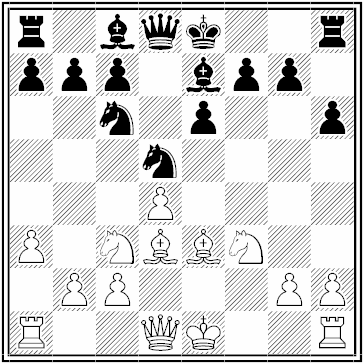
Last post demonstrated my loss after the normal 9.Qf3 c6 10.Nxg6 hxg6 11.Bc4 e6 12.0-0, but since then, I learned that 9.Nxg6 hxg6 10.Bg5 (diagram) is better.

a/ 10...Nf6 ( the Do Nothing variation at its best ) 11.Qe2 (diagram)
...a1/ 11...Qxd4 12.Rd1 (+)
...a2/ 11...Nc6 12.0-0-0 (+=)
...a3/ 11...Nbd7 12.d5 (+=)
...a4/ 11...Nh7 12.Bd2 (+=)
...a5/ 11...Nd5 12.Qb5 (+)
...a6/ 11...e6 12.d5 (+=)
...a7/ 11...c6 12.0-0-0 (+=)

b/ 10...Nb6 11.Qd3
...b1/ 11...Qd7 12.Bg2 (+=)
...b2/ 11...Qd6 12.0-0-0 (+=)
...b3/ 11...c6 12.0-0-0 (+=)
...b4/ 11...Nbd7 12.d5 (+=)

c/ 10...Nc6 11.Bg2
...c1/ 11...Nb6 12.d5 (+=)
...c2/ 11...f6 12.Qd3 (+=)
...c3/ 11...a6 12.Qd3 (+=)
.
d/ 10...c6 11.Qe2
...d1/ 11...Nf6 12.0-0-0 (+=)
...d2/ 11...Qa5 12.Bd2 (+=)
...d3/ 11...Qb6 12.0-0-0 (+=)
...d4/ 11...Qc7 12.0-0-0 (+=)

e/ 10...c5 11.d5
...e1/ 11...Qc7 12.Qf3 (+=)
...e2/ 11...Qb6 12.Qf3 (+=)
...e3/ 11...Qa5 12.Qe2 (+)
...e4/ 11...Ne5 12.Bb5+ (+)
...e5/ 11...f6 12.Bd3 (+)

f/ 10...f6 11.Qd3 (+)

g/ 10...Na6 11.Qf3 (+)

So we see that the simple 10.Bg5 gibes white a simple game, with a small advantage in all lines. A just punishment for black's play !

Wednesday, March 5, 2014

The art of doing nothing

My opponent last weekend excelled in the noble art of doing nothing. He defended. That's all. Waiting in his hideout for me to make a mistake. Not committing anything, but with a sharp eye on the mistake that I would inevitably make. "Show me what you have" seems to be their concept.

It's hard to play that kind of playters, especially in a gambit line, since you did sacrifice the pawn. You gave this kind of opponent the opportunity to act like this, you did give them the pawn. They can just wait for the storm to calm and fight back at that point.

What to do against those opponents ? Play the correct moves, and hope that you can unleash a violent storm - something I failed to do.

1.d4 Nf6 2.f3 d5 3.e4 dxe4 4.Nc3 exf3 5.Nxf3 Bg4 6.h3 Bh5 7.g4 Bg6 8.Ne5 Nfd7 (diagram)
Challenging my outpost in a very unconventional way.

I continued in the normal Teichmann way, not realizing my opponent had embarked on a "Do Nothing" approach.

9.Qf3 c6 10.Nxg6 hxg6 11.Bc4 e6 12.0-0 Qf6 13.Be3 (diagram)
Black has just played the only active move he will ever play, and I failed to take advantage.

13...Qxf3 14.Rxf3 Be7 15.Raf1 Rf8 16.Ne4 Nb6 17.Bb3 Nd5 (diagram)

Black reached a relatively safe outpost for his knight, ( but has not forgotten his concept of play ).
18.Bg5 f6 19.Bd2 a5 20.c4 Nc7 21.Bf4 N8a6 22.Nd6+ Bxd6 23.Bxd6  Rh8 (diagram)

Returning to his home spot ! But actually it is a great move as the rook will go lateron to h5, commanding the 5th line.

And here I suddenly realised I had less than nothing. I have the bishop pair, but black still has a solid position and has the extra pawn. And most of all, I spent 1,5 hours out of my allotted 2 hours for 40 moves to reach an equal position, whilst my opponent had spent only 30 minutes doing nothing. Black clearly has a won game here - talking from a psycological point of view.

In any case, I lost the game. But how to play against the odd 8...Nfd7 ?? My silicon assistant suggests 9.Nxg6 ( a move that needs to be played anyway ) hxg6 and now 10.Bg5 or 10.Bg2, but let's analyse that in the next column.

Friday, February 28, 2014

Learning slowly

I was faced this weekend with one of black's best defenses in the Euwe.

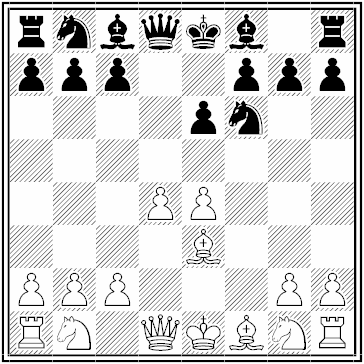
1.d4 d5 2.e4 dxe4 3.Nc3 Nf6 4.f3 exf3 5.Nxf3 e6 6.Bg5 Be7 7.Bd3 h6 8.Be3 Nc6 9.a3 Nd5 (diagram)


I played 10.Qd2 after which black was able to remove the pressure with 10.Qd2 Nxe3 11.Qe3 Bf6 12.Ne2 Qe7 and black was better.

After some thought, it is obvious that 10.Nxd5 is better than 10.Qd2 with following lines :

a/ 10...Qxd5 11.0-0 (diagram)

...a1/ 11...0-0 12.c4 (=)
...a2/ 11...b6 12.c4 (+=)
...a3/ 11...Bf6 12.c4 (=)
...a4/ 11...Bd7 12.c4 (+=)
...a5/ 11...f5 12.Qe2 (=)

b/ 10...exd5 11.0-0 (diagram)

...b1/ 11...0-0 12.Qd2 (=)
...b2/ 11...Bg4 12.Qd2 (=)
...b3/ 11...b6 12.Bb5 (++)
...b4/ 11...a6 12.Qd2 (=)
...b5/ 11...Be6 12.b4 (=)

So we see that black has nothing to fear in this line after 10.Nxd5.

Saturday, February 1, 2014

Tangled Up in Blue.

"".Early one morning the sun was shining, I was lying in bed...." So starts off  the famous Bob Dylan song. That's the feeling I got when I played an ex-Belgian champion yesterday evening. I was playing black, but he surprised my Winawer defense with an ultra sharp line.

Robert Scheurmans - Guido De Bouver
1.e4 e6 2.d4 d5 3.Nc3 Bb4
The Winawer, most often leading to very sharp play

4.e5 c5 5.a3 Bxc3+ 6.bxc3 Qc7  7.Qg4 (diagram)
Leading to the very complicated play

7...Ne7 8.Qxg7 Rg8 9.Qxh7 cxd4 (diagram)
The poisoned pawn variation has come on the board. A complicated line where any mistake by either party has disastreous consequences.

The normal move is now 10.Ne2, however my noted opponent played 10.Kd1 (diagram) here ! This is listed as the Euwe-Gligoric variation in the Poisoned pawn.... Wow. After the game, he copnfessed he knows this line quite well - it seems to be a pet line of GM Uhlmann, THE authority on the French defense.

In any case, the odd king move takes away all of black threads and is very hard to handle for black.

The game continued 10...Nbc6 11.Nf3 Nxe5 12.Bf4 Qxc3 13.Nxe5 (diagram)

After some thought, Houdini rates the position as equal. Black gets the exchange, but the black knight is very strong in his e5 outpost.

13...Qxa1+ 14.Bc1
Yet another surprise. I hqd been hoping for 14.Kd2, so i could draw after 14...Kd3+, but 14.Bc1 avoids the draw. By now, I had consumed already more than 1 hour of my allocated 2 hours for 40 moves, so I started to get very unconfortable.

I now played 14...d3, to block the bishop from coming out. 14...Rg8 would have been better says my silicon assistant, but I was afraid of letting the bishop out, becuase this would allow for the h1 rook to come into play quickly.

14...d3 15.Qxf7+ Kd8 16.Qf6 dxc2+ (diagram)

I had expected 17.Kxc2 Qa2+ 18.Bb2 Bd7 19.Nf7+, but my champion-opponent has again a surprise for me.

17.Kd2 !!
The correct move is now either 17...Qb1 or 17...d4, my move is slightly inferior.

17...Qd4+ 18.Bd3 (diagram)
Complicating things even more as 18.Kxc2 Qc5+ 19.Kb1 Bd7 would have given me some breathing space.

I started to get into time trouble here, with 20 minutes to go in this hugely complicated position ( my opponent only took 15 minutes to get here... ). So I made a mistake. I think I played well till now - 18...Qc5 would have defended e7 and d6. But white didnt see how to benefoit from my miostake.

18...Ke8 19.Qf7+ Kd8 20.Re1 Qa4 (diagram)

White could have taken the advantage by 21.Qf6 but played the inferior 21.Ke2, which allowed me 21...Qe8 22.Qxe8 Kxe8 23.Kf1 (diagram).

Objectively, black is better, but the knight on e5 might be well worth a rook. In any case, I lost the game in time trouble.

Wow, what a game. I am glad I had the opportunity to play this aginst this respected opponent - but I was beaten by a bigger gambiteer. Aftre the game, he confessed he had my Blackmar-Diemer gambit book standing in his library next to Diemer's. What an honour !

Monday, January 27, 2014

Too dull for a gambiteer

My opponent yesterday avoided my Blackmar Diemer by a boring line which ended, not unexpectedly, in a draw.

1.d4 Nf6 2.f3 e6 3.e4 d5 (diagram)

My opponent, a geniune French defense player, did not want to take any risk at all. I continued with the obvious 4.e5 Nfd7 5.f4 aftre which a drawish game occured.

But can the attacker avoid these French lines after 1.d4 Nf6 2.f3 e6 3.e4 d5. I guess there are some candidates : 4.Nc3 and 4.Be3, the last one resembling an Alapin gambit. Let's look at that one today and explore some possible lines.

4.Be3 dxe5 5.fxe4 (diagram - 5.Nc3 is not good as white has wasted one move compared to a regular Euwe defense, so only 5.fxe4 is avaliable )

Aftre black eating the e4 pawn 5...Nxe4, white plays 6.Nd2. Whiet can equalize and develop quickly if now 6...Nxd2 7.Qxd2 (=)

If black retreats the knight to f6, white also develops quickly and equalises 6...Nf6 7.Ngf3 (=)

Retreating to d6 is a different option 6...Nd6 7.Nf3 (=)

Protecting the knight on its outpost on e4 is no option as 6...f5 7.Nxe4 fxe4 8.Qh5+ as awfull, and 6...Qd5 7.Bc4 brings out the black queen unnecessarily.

So 4.Be3 dxe4 5.fxe4 Nxe4 is not to be feared, as white has a nice lead in development for the pawn.

Let's look at the most typical French move 4...c5 5.dxc5 (diagram)
This was the move that white was trying to prevent aftre all when playing 4.Be3, so it is no wonder white is ok here.

Developing quietly is the third option for black, eg 4...Be7. White can now obvioulsy return to the typical French Tarrasch-like lines aftre 5.e5 Nfd7 6.f4, but we wanted to avoid these boring lines. So why not 5.Nc3 here ? Pinning the knight would be a waste of time. Houdini gives me complete equaliyty here.
So it seems the 4.Be3 is playable and avoids the boring Tarrasch lines.

To be noted is that 1.e4 e6 2.d4 d5 3.Nc3 Nf6 4.Be3 is called the Henneberger Variation of the French.

Stay posted for more


Sunday, December 22, 2013

Yet another improvement

I was looking for improvements on my game last week, where my opponent was baffled by my audacious 1.d4 d5 2.e4 dxe4 3.Nc3 Nf6 4.f3 exf3 5.Nxf3 Bg4 6.h3 Bh5 7.g4 Bg6 8.Ne5 e6 9.Qf3 Nd5 10.Bb5+ c6 11.0-0.

My opponent choose the inferior 11...f6, but I realised black would get trhe upper hand aftre the correct 11...Nf6, as 12.Rf2 complicates things even further, but black remains on top after the simple 12...Be7.

But now I see that 11.0-0 is in fact the bad move ! 11.Rf1 (diagram) is much stronger.

a/ 11...Qh4+ 12.Kd1
...a1/ 12...cxb5 13.Nxd5 (++)
...a2/ 12...Nxc3+ 13.bxc3 (+=)
...a3/ 12...Be7 13.Nxd5 (+=)
...a4/ 12...f6 13.Nxd5 (++)
...a5/ 12...Qf6 13.Qg2 (=)
...a6/ 12...Qe7 13.Nxd5 (++)
...a7/ 12...Bd6 13.Nxg6 (++)

b/ 11...cxb5 12.Nxg6 (++)

c/ 11...Nf6 12.Be2 (=)

d/ 11...Qf6 12.Nxd5
...d1/ 12...exd5 13.Qxd5 (+=)
...d2/ 12...Qxf3 13.Nc7+ Kd8 14.Rxf3 Kxc7 15.Nxf7 (+)

e/ 11...f6 12.Nxg6 hxg6 13.Bd3 (=)

f/ 11...f5 12.Nxd5 
...f1/ 12...Qxd5 13.Qxd5 exd5 14.Bd3 (+=)
...f2/ 12...exd5 13.Bd3 (+=)

So it seems to me that 11.Rf1 is much stronger than 11.0-0. There is no advantage in sight for black and he will soon be drowning the terrible complications against a well prepared attacker.

Also, black can hold in three lines :
> 11...Qh4+ 12.Kd1 Qf6 Qg2
> 11...Nf6 12.Be2
> 11...f6 12.Nxg6 hxg6 13.Bd3

My next post will focus on these lines.

Monday, December 16, 2013

The jungle of variations

Yesterday afternoon I played an interesting Blackmar Diemer - I didnt win the game, as I lost the way in the jungle of variations myself.

Guido De Bouver - Patrick Colemont
Belgian interclubs. 15-dec-2013.

1.d4 d5 2.e4 dxe4 3.Nc3 Nf6 4.f3 exf3 5.Nxf3 Bg4 6.h3 Bh5 7.g4 Bg6 8.Ne5 e6 9.Qf3
All according to plan - the Teichmann defense

9...Nd5?! (diagram)

Luckily I remembered a great attacking line.
10.Bb5+ c6 11.0-0 (diagram)

11..f6 ?!
The correct move is 11...Nf6 and black should be better somehow, even if 12.Rf2 complicates things for black.

12.Nxg6 hxg6 (diagram)


Now it was turn to make an inferior move :-(
13.Nxd5 ?
The correct move 13.Bd3 should gave given me a small advantage

13...Nxd5 14.Bd3 (diagram)

The defender is better now, but black choose the inferior 14...Kf7.

The remainder of the game was quite spectacular after 15.Be4 Qxd4+ 16.Be3 Qe5, but I was able to secure a draw in a complicated queen versus two rooks endgame.

In any case, I will have to find a decent continuation after black's best move 11.Nf6