Showing posts with label O'Kelly. Show all posts

Sunday, March 19, 2017

Major improvement in GiveAway Declined variation


Just loaded Stockfish 8 and I have to admit, results are spectacular.

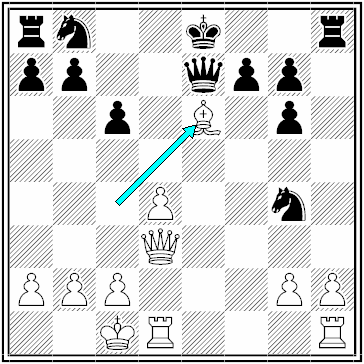
I was still glancing through the positions resulting after the GiveAway variation 1.d4 d5 2.e4 dxe4 3.Nc3 Nf6 4.f3 exf3 5.Nxf3 c6 6.Bc4 Bf5 7.g4 Bg6 when Stockfish 8 quickly found an improvement to 8.h4 and 8.g5, namely 8.Qe2 (diagram)

The order of the moves is key here - white delays h5 or g5 and plays first a waiting move. Only when black commits to a move, white then moves its kingside pawns.

Let's look at a few lines.

A. 8...e6 9.h4
...A1. 9...h6 10.Ne5 (+)
...A2. 9...b5 10.Bb3 (=)
...A3. 9...h5 10.Ne5 (+)
...A4. 9...Bb4 10.h5 (=)
...A5. 9...Nxg4 10.Bg5 (diagram)

......A5a. 10...Be7 11.0-0-0 (=)
......A5b. 10...f6 11.Bxe6 (++)
......A5c. 10...Qc7 11.Bxe6 fxe6 12.Qxe6+ (+=)
......A5d. 10...Qb6 11.Bxe6 (++)
......A5e. 10...Qa5 11.Bxe6 (++)
......A5f. 10...Qd7 11.0-0-0 (++)
......A5g. 10...Qd6 11.0-0-0 (+)

B. 8...b5 9.Bb3
...B1. 9...a5 10.a3 (=)
...B2. 9...b4 10.Na4 (=)
...B3. 9...e6 10.h4 (+=)
...B4. 9...Nbd7 10.h4 (+=)

C. 8...Nxg4 9.Rg1 (+=)

D. 8...Nbd7 9.g5
...D1. 9...b5 10.Bb3 (=)
...D2. 9...Nh5 10.Rf1 (=)
...D3. 9...Nd5 10.0-0 (=+)
...D4. 9...Ng8 10.Bf4 (+)
...D5. 9...Ng4 10.h3 (++)

So it seems Stockfish 8 is much stronger then its previous version - it unearthed a simple improved to the GiveAway Declined variation in a matter of minutes.
Now fix the GiveAway Accepted !!!

Saturday, March 18, 2017

Dispair in the GiveAway variation

hello Blackmar Diemer fans,

Yesterday evening I played a few blitz games in my local chess club, several of them were based on the Ziegler/O'Kelly defense

1.d4 d5 2.e4 dxe4 3.Nc3 Nf6 4.f3 exf3 5.Nxf3 c6 6.Bc4 Bf5 when I venture the surprising 7.g4 !!
Because of obvious reasons, I called this the GiveAway variation.

Black should of course accept the gift and capture 7...Nxg4, but yesterday evening, most of my opponents choose to play it carefully with 7...Bg6

What can now complicate things again with yet another sacrifice 8.h4!!  Nxg4 9.Ng5 (diagram)

Black has two moves 9...h5 and 9...Nh6

After the seemingly robust 9...Nh6, white gets great attacking chances with 10.Qe2 (diagram)
A. 10...Qxd4 11.Be3 Qg4 12.Qxg4 Nxg4 13.h5 (=)
B. 10...Qc7 11.Be3 (=)
C. 10...e6 11.d5 (=)
D. 10...b5 11.Bb3 (=)
E. 10...Nd7 11.Bf4 (=)

So the robust 9...Nh6 does not offer any advantages, let's look at the more aggressive 9...h5 10.Bf4 (diagram)
White is risking all here and black can remian on top in various ways
F. 10...b5 11.Bb3 e6 12.Qe2 Bb4 13.Bxe6 (=+)
G. 10...e6 11.Qe2 Bb4 12.0-0-0 0-0 13.Bd3 (=+)
H. 10...Nd7 11.Qe2 Nb6 12.Bb3 (=+)

So it seems the ultra aggressive 8.h4 is not so good if black decline sthe pawn in the GiveAway variation. The problem is that 8.g5 might not offer better prospects 😓 aftre 8.g5 Nd5 (diagram)


Wednesday, April 27, 2016

Start Trek continued

Hope you enjoyed the "Star Trek" idea from last post. Let's look at another line today - for the fun of it !

1.d4 d5 2.e4 dxe4 3.Nc3 Nf6 4.f3 exf3 5.Nxf3 c6 6.Bc4 Bf5 7.Ne5 e6 8.Nxf7 ?? Kxf7 9.0-0 Bg6 10.Qe2 (diagram)


Alternatives to 10.Qe2 are 10.Qg4, 10.Bf4 and 10.Re1 - maybe they provide white with a better attack - check it out yourself.

10...Qxd4+ 11.Kh1 Qd7 12.Bg5 (diagram)
"The proof of the pudding is in the eating" - the only way for black to maintain a clear lead is by taking another pawn and thus opening even more lines - thus risking even more.


Black now has two options to moves to maintain his lead : 12...Na6 and 12...b5.

Let's look at the first : 12...Na6 ( a6 is obviously not the target for the horseman as it wants to defend the e6 pawn from the relatively safe c7 square ) 13.Rad1 Qe7 14.Ne4 Bxe4 15.Qxe4 Nac7 (diagram)

I have to admit, I am here a bit without ideas to continue the attack. White's pieces are all over the board, but black defends everything - and has an extra piece and pawn !!

Any imporvements ??

Saturday, April 16, 2016

The Star Trek attack.

Some 15 years ago, when I started to get interested in the Blackmar Diemer, I was often faced with the annoying O'Kelly defense. Over time, I learned to deal with it, but at the time, it was a defense that made me tremble with fear.

So I started to investigate stange lines, to make the attack playable - that's how I come to discover the Start Trek attack : "To boldly go were no man has gone before"... I remember the feedback from a fellow BDG author : "That 's quite optimistic ?!"

Anyway, here is the Star Trek attack : 1.d4 d5 2.e4 dxe4 3.Nc3 Nf6 4.f3 exf3 5.Nxf3 c6 6.Bc4 Bf5 7.Ne5 e6 8.Nxf7 ?? Kxf7 9.0-0

Let's look at black's most natural response : 9...Ke8 10.Kh1 (diagram)
I often need this move, so why not play it immediately - it allows me to wait for black's move and respond accordingly.

Let's look at one of black's most normal moves : 10...Nbd7 11.Qe2 (diagram)

Black has many moves at his disposal, let's see what happens if he tries to defend the pawn with 11...Qe7 12.Bg5 (diagram)

Black can now try to run in his king to safety, eg 12...Kd8 13.Rae1 Kc7 14.Bf4+ Kc8 15.h3 and with has compensation for the piece

From the starting position above, the defender could try to initiate a pawn storm on the white king : 12...h6 13.Bh4 g5 14.Bg3 h5 15.Rae1 h4 16.Bd6 with a difficult position

Lastly, the normal line 12...Nb6 13.Bb3 Nbd5 brings equal play after 14.Bxd5

So it sure seems the Star Trek attack might be worth a closer look !

Saturday, March 12, 2016

O'Kelly is OK

Some say that the O'Kelly is a great defense - that might be true.

However, I say, the O'Kelly line is a great attack - the game I played yesterday evening proves so.

Guido De Bouver - Bram Verschoren
Mechelen, 2016

1.d4 Nf6 2.f3 d5 3.e4 dxe4 4.Nc3 exf3 5.Nxf3 c6 6.Bc4 Bf5 7.g4 !!

As suggested in a famous Chesscafe article.

7...Nxg4 8.Nh4 g6 9.h3 Nf6 10.Bg5 e6 ?

Better would have been 10...Ne4. But in the game, I now missed the equalizing move : 11.d5 !!

11.Qe2 Be7 12.0-0-0 Nd5

With two pawns up, black exchanges a few pieces. Cant be bad...

13.Bxe7 Nxc3 14.Qe5.

Black now makes a horrible mistake. Simply 14...Kxe7 would have left me with 15.bxc3 Nd7 and black won a very important tempo as compared to the actual game.

14...Nax2+ 15.Bxa2 Ke7

Now I have a crucial extra move for the pawn, which allows me to open up the centre. However, when returning home, my silicon assistant says 16.Nxf5 gxf5 17.Rhe1 is actually a lot better for white.

16.d5 cxd5 17.Nxf5 gxf5 18.Rhe1


18...Qa5 19.Rxd5

Here my opponent took the piece on a2 and suggested a draw. Myself, I had a terrible headache and did not want to look any further and agreed to the draw, as we both saw 19...Qxa2 20.Qd6+ Kf6 21.Qe5+ with a perpetual check.

However, the position allows for a mate in 6, can you find it ?

19...Qxa2 20.Qd6+ Kf6 21.Rxf5+ !!

Ouch !! that hurts.

21...Kxf5 22.Qe5+ Kg6 23.Rg1 Kh6 24.Qg5 mate.

Pity I did not see that finish... But I certainly know now that the O'Kelly defense is actually a great attack.

Sunday, June 28, 2015

The defender becomes the attacker.

The immediate 7.g4 is a rude answer to black's trustowrthy O'Kelly defense. But is it correct ? Probably not, but that wont keep me from winning with it.

1.d4 d5 2.e4 dxe4 3.Nc3 Nf6 4.f3 exf3 5.Nxf3 c6 6.Bc4 Bf5
The O'kelly, which can lead to the Ziegler defense, but white has other plans.

7.g4 !!! (diagram)

7...Nxg4 8.Nh4 g6 9.Nxf5 gxf5 10.h3 Nf6 11.Bg5 e6 12.d5
A key move for the attacker

12...cxd5 13.Bxd5 (diagram)


13...Nbd7 14.Bxb7 Rb8
probably not the best move. 14...Be7 15.Qf3 Rb8 16.Rd1 would give black a small advantage, but it very unlikely any defender would have been able to get this far without mistakes.

15.Bc6 Qb6 (diagram)
best

let's look at the situation : white is a pawn down and his king is defenseless. Black on the other hand has whaethered the storm and is now starting to deploy his forces. So it seems white can safely resign here, isnt it ?

16.Qf3 Be7 17.Rd1 Rd8 18.Ke2

White is desperately trying to get some space as to centralize his pieces

18...h6 19.Bxf6 Bxf6 20.Rxd7 Rxd7 21.Rd1 0-0 22.Rxd7 23.Qxb2 Kd2


White is a piece ahead for two pawns, but it is black who has the safer king and the king. White may be able to survive but it wont be easy. But then again, chances are low that black will be able to get this far against a well prepared white berserker.


Friday, September 5, 2014

The times they are a changing.

Yes, the times they are a-changing. And so does the evaluation of some wild Blackmar Diemer lines.

Take the obscure line in teh Ziegler ( aka O'kelly ) defense 1.d4 d5 2.e4 dxe4 3.Nc3 Nf6 4.f3 exf3 5.Nxf3 c6 6.Bc4 Bf5 7.g4  !! This line was suggested by IM Stefan Bucker in a famous article published in 2010 on chesscafe.com.

I have played trhis lately twice in five minute games on chess.com and both of my opponents went astray quickly. And also, the gambit has some real potency. Look at the line

7...Nxg4 8.Nh4 g6 9.Nxf5 gxf5 10.h3 Nf6 11.Bg5 e6 and now 12.d5 (diagram)

I challenge you to defend this position here as black. Not simple, is it ?

I wont go as far as saying that 7.g4 is better than 7.Bg5. I wont play it, certainly not in rated over-the-board games, but it is perfect for blitz games.

And who knows, maybe one day, the times will be changing...


Thursday, August 7, 2014

Fixing the Ziegler

My previous post "A blow to the Ziegler" showed some problems in the "new" Ziegler lines.

After 1.d4 d5 2.e4 dxe4 3.Nc3 Nf6 4.f3 exf3 5.Nxf3 c6 6.Bc4 Bf5 7.Bg5 e6 8.Nh4 Bg6 9.Nxg6 hxg6 10.Qd3 Be7 11.0-0-0 Ng4, black seems to be clearly on top.

Not that this is the only problem to be fixed - after 11.0-0-0, a quick scan with Stockfish unearths many more problematic black moves, but that is another problem...

Back to the lines aftre 11...Ng4. It is obvious that 12.Bxe7 Qxe7 are necessary.

In my previous post, I only considered the aggressive 13.Bxe6, but now I am pretty sure that 13.Qf3 (diagram) is the best move.


It seems to me that both 13...Nf6 and 13...Qh4 are possible for black. Let;s look at 13...Nf6. White now tries to open the centre with 14.d5 (diagram).


It seems to me white has at leats an equal game in all lines, apart from one : 14...Rh4 !!! (diagram) Obviously, this move is hard to find over the board, but it poses white some serious problems.


a/ 15.d6 Qd8 16.Qe2
...a1/ 16...Nbd7 17.Kb1 (=) to (=+)
...a2/ 16...b5 17.Bxe6 fxe6 18.Qxe6+ Kf8 19.g3 (=)
...a3/ 16...Kf8 17.g3 (=)

b/ 15.Bb3
...b1/ 15...cxd5 16.Rhe1 (=+)
...b2/ 15...Nxd5 16.Nxd5 cxd5 17.Rhe1 (=+)

c/ 15.dxe6 Rxc4 16.exf7+ Kxf7 17.Rhe1 Qc7 18.Ne4 Rxe4!! 19.Rxe4 Nbd7 (=+)

d/ 15.dxc6 Nxc6 16.Bb5 Qc7 (=+)

So we see that 13.Qf3 Nf6 14.d5 Rh4 15.d6 Qd8 16.Qe2 gives a hard, but playable game.

What a relief, I beleived for some time the Ziegler actually did refute the Blackmar Diemer ! but that does not seem to be the case - provided I can fix all other problems :-(

Tuesday, June 24, 2014

A blow to the Ziegler

The Ziegler defense ( 1.d4 d5 2.e4 dxe4 3.Nc3 Nf6 4.f3 exf3 5.Nxf3 c6 6.Bc4 Bf5 has always posed a problem to the attacker as the traditional lines 7.0-0 e6 8.Ne5 is insufficient.

However, 7.Bg5 e6 8.Nh4 Bg6 9.Nxg6 hxg6 10.Qd3 (diagram) gives white decent chances.

Blitz play this morning continued 10...Be7 11.0-0-0 and now the new move 11...Ng4 (diagram)

Black wants to exchange some pieces and eyes the f2 square for his jumper - what can you expect more from a move ?

Play went 12.Bxe7 Qxe7 and now I threw in the standard sacrifice 12.Bxe6 (diagram)

Obvioulsy, I was hoping for 13...fxe6 14.Qxg6+ (++), but that would have been too easy.

My blitz opponent played 13...Qg5+ 14.Kb1 fxe6 and now 15.Qg3 (diagram)

Here I thought that white had the advantage, as I have two interesting attacking options
- the knight is pinned and can ve attacjed by means of the simple h3
- my knight can attack the queen with Ne4 and the check on d6.

But it seems that it is actually black who is on top. My trusted silicon assistant gives 15...Qh4 16.Qc7 0-0 17.Qxb7 Nf2 18.Qxa8 Nxh1 19.Qxa7, with black having the piece for two pawns.

Have we discovered the real refutation of white's alternative line in the Ziegler( or O'Kelly ) defense ? It surely looks so....


Wednesday, November 13, 2013

The Euwe - O'Kelly : One move less also wins

My previous post on the "Euwe - O'Kelly defense" raised some comments. User "Anonymous" suggested 11.Bd3 (diagram) in the position after 1.d4 d5 2.e4 dxe4 3.Nc3 Nf6 4.f3 exf3 5.Nxf3 c6 6.Bc4 e6 7.0-0 Be7 8.Qe1 Nbd7 9.Bg5 0-0 10.Qh4 h6. In my post, I only considered 11.Bxh6 with equal play ( provided black find sthe right moves !! )


This position might seem familiar to the attentive reader as this position can be reached in the EUwe defense after 1.d4 d5 2.e4 dxe4 3.Nc3 Nf6 4.f3 exf3 5.Nxf3 e6 6.Bg5 Be7 7.Bd3 Nbd7 8.0-0 0-0 9.Qe1 c6 10.Qh4 h6. The only difference is that it is white to move in the Euwe, whilst it is black's turn in the Euwe-O'Kelly. Talking about a small difference.

But even with white one move down, it seems that 11.Bd3 is winning !!

a/ 11...hxg5 12.Nxg5 (++)

b/ 11...Nb6 12.Bxh6 (++)

c/ 11...Nd5  12.Nxd5 Bxg5 13.Nxg5 Qxg5 14.Qxg5 hxg5 15.Ne7+ Kh8 16.Rae1 (+=)

d/ 11...Qa5 12.Ne4
...d1/ 12...Re8 13.Rae1 (+)
...d2/ 12...Rd8 13.c3 (+)
...d3/ 12...Bd8 13.b4 (+)
...d4/ 12...hxg6 13.Nexg5 (++)

e/ 11...Qb6 12.Bxh6 (++)

f/ 11...Qc7 12.Bxh6 (++)

g/ 11...c5 12.Bxh6 (++)

Let's consider balck's best reply in more detail : 11...Re8 12.Bxh6 (diagram)

Declining the piece is no option for black :

...h1/ 12...Nf8 13.Ne5 (++)
...h2/ 12...Nd5 13.Nh7+ (++)
...h3/ 12...Qa5 13.Bg5 (++)

And now the killer move 12...gxh6 13.Ne5 !! Analysis shows only 13...Bf8 offers some chances. But now white brings in an extra piece with 14.Rf3 (diagram)

Again, black has only one move 14...Bg7, followed by the logical 15.Rg3 (diagram)

As "Anonymous" pointed out, black has to give back the piece with 15...Ne4, but white stays on top after 16.Qxe4 f5 17.Qe3 Nxe5 18.Qxe5 (+=)

Apparently, the Euwe defense is so strong that it evens wins with the move down !

Thank you "Anonymous" for this great line !