Showing posts with label Paleface. Show all posts

Saturday, May 16, 2015

Further madness

The yearly speed championship started yesterday evening in my local chessclub - each player is alloted 25 minutes of time with a 10 seconds move increment. Ideal for a Blackmar Diemer. But unfortunately, my first opponent refrained from playing d5, so I had to revert to some other madness.

1.d4 Nf6 2.f3 g6
What player is so unreasonable as to refuse to enter the Blackmar Diemer ? He should be punished immediately with ...

3.g4
That got him thinking !

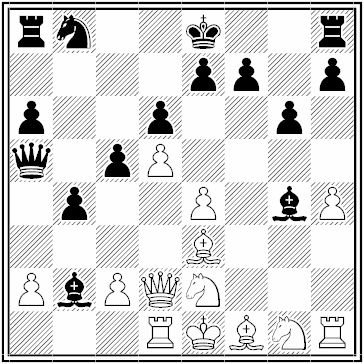
3...Bg7 4.h4 (diagram)
You cant say I am not consistent in my moves :-)

4...d6 5.h5 gxh5 6.g5

6...Nfd7
The other option is 6...Nd5 7.e4 Nb6 8.Ne2, which is probably better for white.

7.e4
Here my opponent choose the inferior 7...e5 and I could easily get the advantage with 8.d5.

The obvious critical line is 7...c5 and we reach the standard Paleface setup after 8.d5 (diagram)

My silicon assistant gives following line as best : 8...h6 9.gxh6 Bxh6 10.Bxh6 Rxh6 11.Qd2 with a slight advantage for white.

I cant find any games on this line in nay database, but the moves 1.d4 Nf6 2.f3 g6 3.g4 certainly seem playable. Please let me know if you had any experience with this.

Sunday, November 9, 2014

If only I could remember

It is now three years and a half that I wrote my blog "Wild, wilder, wildest" on the line 1.d4 Nf6 2.f3 c5 3.d5 e6 4.e4 exd5 5.e5 (diagram)

And last friday, it actually happended - I got this positioning on the board in an offical rated game - if only I could have remembered the correct moves.

Guido De Bouver - Thomas Schurins
1.d4 Nf6 2.f3 c5 3.d5 e6 4.e4 exd5 5.e5 Qe7 6.Qe2 Nh5 ?! (diagram)

Obviously, I had forgotten about the correct move now ( more on that below ), and played for winning the piece 7.g4. This wins a piece for two pawns, but my pawn structure gets suboptimal - to say the least.

7.g4 d6 8.gxh5 dxe5 (diagram)

At this point, I decided to defend my pawns on the h file ar every cost, hoping I could stand his impressive pawn centre.

9.h4 Nc6 10.Be3 Bf5 11.c3 d4 12.Bf2 (diagram)

So far, I have been able to hold on to my defense of the h pawns. But now things get more complicated as my opponent opens up the h file for his rook. Unfortunately, this opens a great diagonal for his black squared bishop.

12...g6 13.hxg6 hxg6 14.Bh3 d3 !! (diagram)
My queen wil get kicked around, so it is back to square zero.

15.Qd1 e4 16.Bxf5 gxf5 17.Qd2 Bh6 18.f4 Ne5 (diagram)

The rest of the game is not of further interest to us, but at this stage, I am still a pieve for two pawns ahead, I have preserved my h pawn, even got rid of the double h pawn. So I achieved what I was hoping for inthe opening, but the price I have to pay for it is quite high as black has a giganic centre with two passers,

In any case, I won the game - in fact, it was my h pawn that I treasured so much, that promoted into a queen. But I can hardly say that I was better in the last diagrammed position.

So dont play this line like this ! The correct move after  1.d4 Nf6 2.f3 c5 3.d5 e6 4.e4 exd5 5.e4 Qe7 6.Qe2 Nh5 is 7.Nc3 (diagram)

Black is completely lost as his queen will get kicked around the battle field, eg 7...Qe6 8.f4 g6 9.f5 !! (diagram)

In my analysis during the game, I had considered 7.Nc3 Qe6 8.f4 g6, but the crushing 9.f5 is hard to see at the board. Black is completely lost in this position, eg

a/ 9...gxf5 10.Qxh5 (++)

b/ 9...Qxf5 10.g4 Qe6 11.gxh5 (++)

c/ 9...Qc6 10.g4 Ng7 11.Bg2 (++)

So continue to read these lines - and remember them !

Sunday, September 21, 2014

The sacrifice on e4 in the Paleface Pirc

Yesterday I was crushed to death in a Paleface Pirc. The game was played at fast speed, but still, I was sort of humiliated with my opening. read carefully so you dont end up like this !

Guido De Bouver - Roel Hamblok ( Antwerpen )
1.d4 c5 2.d5 g6 3.e4 Bg7 4.Nc3 d6 5.Be3 Nf6 6.Qd2 Qa5 7.f3 a6 8.g4 b5 (diagram)

White has declared his intentions on the kingside whilst blacks expands on the queenside - a typical idea in the Paleface Pirc.

My next move was too slow : 9.h4. This move is too slow as it allows for 9...h5, but my opponent had a different plan : 9...b4 (diagram)

Oh horror - black is attacking a piece first. Probably an indication that I am not doing so well. But now I missed a simple sacrifice.

10.Nce2 ??? (diagram)

As soon as I released my piece, I saw the combination. 10.Nd1 would have been ok for white.

10...Nxe4 Of course.
11.fxe4 Bxb2 12.Rad1 Bxg4 (diagram)


And with one piece for three pawns, I could safely resign here as my position is hopeless.

Dont fall for this idea - it can happen in other Paleface Pirc positions also.


Wednesday, May 14, 2014

Sometimes the attacker has to defend first

I already covered an interesting line in the Paleface in earlier articles : 1.d4 Nf6 2.f3 g6 3.e4 d6 4.Be3 Bg7 5.Qd2 0-0 6.Nc3 c6 7.0-0-0 b5 8.g4 b4. In these articles, I showed that 9.Nce2 is not to be feared as 9...Qa5 can be countered by the simple, yet effective 10.Kb1

Yesterday my blitz opponent played differently and comtinued 1.d4 Nf6 2.f3 g6 3.e4 d6 4.Be3 Bg7 5.Qd2 0-0 6.Nc3 c6 7.0-0-0 b5 8.g4 Qa4 (diagram).

In good Blackmar-Diemer style, I attacked on the opposite end with 9.h4, but came in a difficult position after 9...b4 10.Nce2 Qxa2 11.Qxb4. Black now tried to open up things further with 11...c5 and I found myself quickly in a mating net.

So it is obvious that 9.h4 is far to slow - black's threats have to be dealt with first - I realize this is hard to accept for a Blackmar Diemer gambiteer :-(

After analysis it seems there are multiple white candidates : 9.a3, 9.Kb1, 9.g5, maybe even 9.b3 ( which I dont like as it opens the whole diagonal for the black bishop ).

9.g5 (diagram) seems insufficient as the black knigt can safely jump to h5, halting white's attack. White now has to play a3 or Kb1 anyway, so this seems like a loss of time.

White can transpose into the lines described earlier by 9.Kb1 b4 10.Nce2 with an equal game.

9.a3 b4 10.Na2 (diagram) seems the best option for white
10...c5 seems the most dangerous continuation here, but white has nothing to fear after 11.Kb1.
10...Na6 is met by the simple 11.Bxa6 and white is on top.

So there is nothing to fear in the Paleface - provided the gambiteer defends from time to time...

Sunday, March 31, 2013

An alternative, but incorrect move order

Playing with the black pieces, my friend faced an unusual Blackmar Diemer opening last friday in our teammatch. The move order was as follows : 1.d4 Nf6 2.f3 d5 and now the surprising 3.Nc3!! (diagram)

Play continued 3...Bf5 and a Vienna game appeared after 4.e4 dxe4 5.fxe4 Nxe4 6.Qf3.

Personally, I have never seen this move order, with 3.Nc3 preceding 3.e4 in the Paleface. But can black take advantage of this rather strange move order ? Immediately after the game, I suggested 3...c5 (diagram) and my silicon friend agrees.

The f3 pawn now looks rather silly, unless of course white pulls off 4.e4 anyway. But this seems to give black the advantage after 4.e4 cxd4 5.Qxd4 Nc6 6.Bb5 Bd7 and black is doing great.

So the suggested move order 1.d4 Nf6 2.f3 d5 3.Nc3 is refuted by an immediate c5 as the white f3 pawn is useless.


Tuesday, December 18, 2012

Latest on the Paleface Pirc

Last blog covered the poosition after 1.d4 Nf6 2.f3 g6 3.e4 d6 4.Be3 Bg7 5.Qd2 00 6.Nc3 c6 7.000 b5 8.g4 b4. We learned that white is able to hold, but black has the better game after the daring 9.Na4.

In the actual game, I played 9.Nb1 but it seems black gets a nice lead after 9...Qa5 10.a3 c5.

That brings us to white's last option 9.Nce2 (diagram). White denies black of an immediate target and increases the pressure on black's king side as the knight can now quickly move to g3 or f4 to support the advance of the g and h pawns.

Black has a large range of replies, but none seems to provide an advantage.

a/ 9...Qa5 10.Kb1 (diagram)
...a1/ 10...c5 11.h4 (=)
...a2/ 10...Rd8 11.Nc1 (+=)
...a3/ 10...Be6 11.Nc1 (+=)
...a4/ 10...Bd7 11.Nc1 (+=)
...a5/ 10...Bb7 11.h4 (+=)
...a6/ 10...Ba6 11.h4 (=)
...a7/ 10...Na6 11.g5 (+=)
...a8/ 10...Ba6 11.h4 (=)
...a9/ 10...Nbd7 11.g5 (=)
...a0/ 10...Nfd7 11.h4 (+=)
...aA/ 10...Ne8 11.h4 (+=)
...aB/ 10...d5 11.e5 (+=)
...aC/ 10...h5 11.gxh5 (+=)
...aD/ 10...a6 11.Nc1 (+=)

b/ 9...Qb6 10.Nf4 (+=)

c/ 9...Qc7 10.Nf4 (+=)

d/ 9...a5 10.h4 (diagram)
...d1/ 10...a4 11.h5 ( more prudent than 11.Qxb4 )
......d1a/ 11...b3 12.cxb3 axb3 13.a3 (+=)
......d1b/ 11...Qa5 12.Nf4 (+=)
...d2/ 10...h5 11.Nf4 hxg4 12.h5 (+=)
...d3/ 10...Qb6 11.h5 (+=)
...d4/ 10...Ba6 11.Bh6 (+=)

e/ 9...Ba6 10.h4 ( again more prudent than 11.Qxb4 )
...e1/ 10...Qa5 11.h5 !! Qxa2 12.Qxb4 (=)
...e2/ 10...h5 11.Ng3 (+=)
...e3/ 10...Nd7 11.h5 (+=)

f/ 9...d5 10.e5 (+=)

g/ 9...c5 10.dxc5 Qa5 11.g5
...g1/ 11...Ne8 12.Kb1 (=)
...g2/ 11...Nfd7 12.cxd6 Qxa2 13.Qxb4 (+=)
...g3/ 11...Nh5 12.Kb1 (=)

h/ 9...h5 10.gxh5 Nxh5 11.Ng3 ( safer than 11.Qxb4 )
...h1/ 11...Nf6 12.h4 (+=)
...h2/ 11...Qa5 12.Kb1 (+=)
...h3/ 11...Nxg3 12.hxg3 (+)


So we see that white gets great attacking lines after 9.Nce2. Black is able to equalize in some lines - but hey, that's life !


Wednesday, December 5, 2012

The Paleface Pirc - Both Ends Burning.

I got the title from an old Roxy Music song, but actually, the title should be "Both Sides Burning" as both players hurried to attack the king. Who will be first ? And can the slowest still keep up ?

Yesterday I played in the Belgian teamcompetiotion, and my opponent didn't dare to move into a Blackmar Diemer. Instead he moved into a Pirc, but the positions didn't get any simpler, with both players attacking on opposite sides.

Guido De Bouver - Kristian Pade Frederiksen
1.d4 Nf6 2.f3 g6 3.e4 d6 4.Be3 Bg7 5.Qd2
As in the game Anand - Gurevich, that is covered in an earlier blog

5...00 6.Nc3 c6 7.000 b5 8.g4 b4 (diagram)

Black attacks on the queenside, and white will throw everything on the kingside. But who will be first ? It seems black is ahead, as he is chasing the knight already, but that not really the case. Anyway, where should the white knight go ? It is really a crucial decision for the remainder of the game. I played 9.Nb1, but would 9.Na4 not be better ? ( see short analysis below ).

9.Nb1 a5
9...Qa5 10.a3 seems better for black.

10.h4 h5 (diagram)
Stopping the lightning is not easy, as my favourite Blackmar Diemer author used to say in his Keybook.

11.e5 dxe5 12.dxe5 Qxd2 13.Bxd2 Nd5 14.gxh5 Bxe5 (diagram)

A terribly complicated postition occured in the game, with white having two rooks at the enemy kings. Unfortunately, I blundered away a rook in a winning position and had to content with a draw.

But after 8...b4 (diagram above), what should white play ? 9.Nb1, 9.Ne2 or 9.Na4 ? Today, let's briefly look at the lines after 9.Na4 (diagram)

The most challenging reply is clearly 9...Qa5. Let's look briefly at the other lines.

a/ 9..a5 10.g5
...a1/ 10...Nh5 11.Bc4 (=)
...a2/ 10...Nfd7 11.h4 (+=)
...a3/ 10...Ne8 11.h4 (+=)

b/ 9...c5 10.dxc5
...b1/ 10...Nc6 11.cxd6 (+=)
...b2/ 10...Qa5 11.b3 (+=)

c/ 9...Na6 10.b3
...c1/ 10...Qa5 (transposing to xxx)
...c2/ 10...Qc7 11.h4 h5 12.Bh6 (=)
...c3/ 10...h5 11.gxh5 Nxh5 12.Ne2 (+=)

d/ 9...Nbd7 10.Qxb4 Rb8 11.Qd2 (+=)

So refraining from 9...Qa5 does not bring any advantage for black. let's look now at the main line (diagram)

e/ 9...Qa5 10.b3
...e1/ 10...Bd7 11.a3
......e1a/ 11...c5 12.axb4
.........e1a1/ 12...cxb4 13.Kb2 (=)
.........e1a2/ 12...Qxb4 13.Qxb4 cxb4 14.Nb2 (=)
......e1b/ 11...Na6 12.g5
.........e1b1/ 12...Nh5 13.Qe2 (=)
.........e1b2/ 12...Ne8 13.h4 (=)
...e2/ 10...Nfd7 11.h4
......e2a/ 11...Nb6 12.h5 Nxa4 13.bxa4 (=)
......e2b/ 11...c5 12.h5 cxd4 13.Bh6 (+=)
......e2c/ 11...Ba6 12.h5 (+=)
......e2d/ 11...h5 12.Bg5 (+=)
......e2e/ 11...Rd8 12.h5 (+=)
...e3/ 10...Nbd7 11.g5
......e3a/ 11...Nh5 12.Kb1 (=)
......e3b/ 11...Ne8 12.h4 (=)
...e4/ 10...Na6 11.h4 (=)


So it seems white is just able to hold after the critical 9.Na4 Qa5 10.b3, white might even be able to get an attack himself in some lines, but black surely has the attack.

So let's put 9.Na4 to bed quickly. In next post, I will look into 9.Nce2 in more detail. Stay tuned !

Saturday, December 1, 2012

A simple and clear reaction

In our club, I played yesterday a great Paleface against a junior. Not a junior in the sense that he is new in chess. No, junior in the sense of still being young, not crippled with traditionals fears and ideas that older people are suffering from. Junior, in the sense of being open to new ideas. Anyway, he was just back from Maribor (Slovenia ), where he participated in the world youth championship.  So I realised I was not playing against mr Nobody.

I opened with 1.d4, as always. He replied Nf6. Then I gave it a few minutes or so of thought, giving him the impression I wanted to experiment something, and played 2.f3. His facial reaction was simple and clear, a sign of unbelieve ( After the game he said he could not believe his eyes after my first move - this could not be a serious move. But he admitted my opening had worked out ! ). The game continued as follows :

Guido De Bouver - Karsten Verhasselt
1.d4 Nf6 2.f3 e6 3.e4 b6 4.Be3 Bb7 5.Nc3 d5 6.e5 Nfd7 7.f4 c5 8.Nf3 Nc6 9.Be2
Now my young opponent played 9...g6 (diagram). He said he wanted to stop the advance of the f pawn - guess the remainder of the game proves this was not the right recipe to do so

10.00 a6
A logical move after g6, preparing for king side fianchetto

11.Qe1 Be7 (?) 12.Qg3 c4(?!)
Intending the win space on the queenside, and follow up b5.

13.f5 (!) (diagram)

13...gxf5 14.Qg7 Rf8 15.Bh6 Qc7 16.Qxh7 000 17.Bxf8 Rxf8 (diagram)

A very wild and complicated game followed, leading only to a draw as the combinational skills of my young opponent proved too strong.

So, surprise your opponent as early as move 2 - play the paleface and get a clear advantage ! Guess that was the only way for me to draw this promising junior...

Sunday, July 29, 2012

Does this look like a Frenchman ?

A weird French position occurs after 1.d4 Nf6 2.f3 d5 3.e4 e6 4.e5 Nfd7 5.f4 c5 6.c3 Nc6 7.Nf3 (diagram). It looks like a French defense, but differs a lot, since the knight is not at e7 but at d7.

Today, we will look at black's strongest continuation 7...Qb6 8.Be2 (diagram)

a/ 8...Be7 9.00 00 10.Kh1 
A completely equal position has occured. Black has tremendous problems in developing his light squared bishop. Unfortunately, white does not have any immediate target either.


b/ 8...cxd4 9.cxd4
The inclusion of the natural exchange on d4 favours white as it frees the c3 square for the knight.
...b1/ 9...Be7 10.00 (=)
...b2/ 9...a6 10.00 (=)
...b3/ 9...Bb4+ 10.Nc3 (+=)
...b4/ 9...f6 10.Nc3 (+=)


c/ 8...f6 9.00
...c1/ 9...Be7 10.Kh1 (=)
...c2/ 9...fxe5 10.dxe5 (+=)
...c3/ 9...f5 10.a3 (+=)


d/ 8...a6 9.00 (=)


Onbiviously, I am just scratching on the surface of these "Frenchish" lines, but is clear that white has nothing to fear.

Tuesday, January 17, 2012

Great plan for the new year !

I was so frustrated yesterday after my bad loss in the Hubsch gambit ( cfr The difficult Hubsch gambit ) against a FIDE master that I reconsidered my earlier blog on a way to avoid the Hubsch ( cfr Wild, wilder, wildest ).

So let's pick up where we started on 1.d4 Nf6 2.f3

I my post Wild, wilder, wildest I considered the continuation 2...c5 3.d5 e6 4.e4 exd5 5.e5 with terrible complications.

Let's look now at 2...c5 3.d5 d6, which might transpose to a kind of Benoni after the suggested 4.c4

The resulting positions after 4...e6 5.Nc3 exd5 6.cxd5 g6 7.e4 Bg7 can be easily reached from the Saemisch variation of the King's Indian Defence ( or through the Benoni ).

Now the most popular line is 8.Bg5

White provokes 8...h6, hoping to make use of its weakness.

8...00 9.Qd2, and now we have reached a very normal position that has appeared so many times in grandmaster play.

Black' options include :

9...a6 10.a4

9...h6 10.Be3 ( my copy of "The complete Benoni" by Lev Psakhis warns against 10.Bxh6 Nxe4 but Houdini fails too see black advantage after 11.Nxe4 Qh4+ 12.g3 Qxh6 13.Qxh6 Bxh6 14.Nd6 )

9...Na6 10.Nge2 ( or 10.Bc4 )

9...Bd7 10.Nge2 ( or 10.a4 )

9...Re8 10.Be2 ( or 10.a4 or 10.Nge2 )

Lots of these lines were favoured by players like Spassky and Korchnoi, so it seems the Blackmar Diemer is only one oddity ( 2.f3 ) away from becoming a regular chess opening !!

Thursday, March 17, 2011

Wild, wilder, wildest

I was twice crashed lately in the Hubsch gambit by master opponents after the 1.d4 Nf6 2.Nc3 d5 3.e4 opening. My strong opponents indicated they would never play 3...dxe4 ( because of the upcoming Blackmar Diemer complications ), and both played the strong 3...Nxe4 4.Nxe4 dxe4 5.Bc4 Nc6 6.c3 e5 7.d5.

The first opponent ( rated 2340 ) tried 7...Ne7, the other player ( rated 2310 ) tried 7...Nb8, both crushing me. After the game, both confirmed to me that this was their prepared response to the Blackmar Diemer tries.
So I said to myself, "Never again !" and decided to focus on 1.d4 Nf6 2.f3 instead - at least I wont be crushed anymore by the Hubsch.

Today I will focus on the line 1.d4 Nf6 2.f3 c5 3.d5 e6 4.e4 exd5 5.e5


Black has three important options : 5...Qe7, 5...Ng8 and 5...Nh5

a/ 5...Qe7 6.Qe2 Ng8 7.Nc3 with slight advantage for white

b/ 5...Ng8 6.Qxd5 with an equal game

c/ 5...Nh5 6.Qe2 ( see diagram ) White threatens to play g4, winning the knight.


This blog looks at black's strongest reply 6...Nc6 7.g4. Other black options will be considered later.

c1/ 7...Nd4 8.Qg2 with very complicated play, eg
c11/ 8...d6 9.Nc3 dxe5 10.gxh5 with roughly equal play
c12/ 8...Qh4+ 9.Kd1 d6 10.Nc3 =
c13/ 8...Qa5+ 9.Nc3 =
c14/ 8...Qe7 9.Kd1 =
c15/ 8...Be7 9.gxh5 +=


c2/ 7...d6 8.exd6+ Be6 9.d7+ Qxd7 10.gxh, again with complicated play
c21/ 10...Be7 11.Bf4 =
c22/ 10...000 11.Bf4 +=
c23/ 10...Bd6 11.Na3 =
c24/ 10...Nd4 11.Qf2 +=


c3/ 7...Be7 8.gxh5 +=

For once, white is not on the gambiting sides...