I partipated in a tournament last weekend. My 5th round opponent knew I played the Blackmar Diemer and was prepared for it, since I had played a Blackmar Diemer against him a year ago or so.
So I had the bad idea of playimng something else...
1.d4 d5 2.c4
No mother what the grandmasters say : bad choice - 2.e4 is far better/
2...c6
The Slav
3.Nf3 Nf6 4.Nc3 dxc4 5.e4 b5 6.Qc2
My knowledge of theory had ended here. Better was 6.e5, entering the Geller gambit.
6...e6 7.a4
Cant be bad, can it ?
7...a6 (diagram)
This cant be right !!!
8.axb5 cxb5 9.Nxb5 (diagram)
I won my gambit pawn back and my position is far better !!!
But my opponent got me into a known Slav ambush.
9...axb5!!! 10.Rxa8 Bb7 11.Ra1
I started to feel unconfortable, especially since my opponent was smiling all the time
11...Nxe4 (diagram)
And here I knew I was in really deep shit
12.Be2
Desperately trying to get my king into safety
12...Bb4+ (diagram)
Black develops quickly
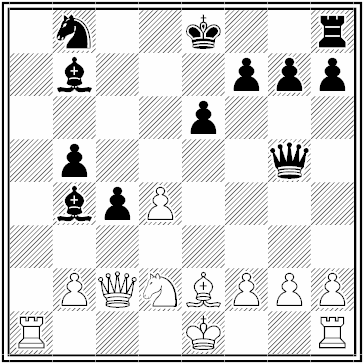
13.Bd2 Nxd2 14.Nxd2 Qg5 (diagram)
Here I decided to resign. My king has no place to go as castling queenside is not possible anymore.
What a nice trap !!
Lessons learned - stick to the Blackmar Diemer and dont mess with Slav gambits.
Showing posts with label Gambits. Show all posts
Tuesday, August 12, 2014
Saturday, February 1, 2014
Tangled Up in Blue.
"".Early one morning the sun was shining, I was lying in bed...." So starts off the famous Bob Dylan song. That's the feeling I got when I played an ex-Belgian champion yesterday evening. I was playing black, but he surprised my Winawer defense with an ultra sharp line.
Robert Scheurmans - Guido De Bouver
1.e4 e6 2.d4 d5 3.Nc3 Bb4
The Winawer, most often leading to very sharp play
4.e5 c5 5.a3 Bxc3+ 6.bxc3 Qc7 7.Qg4 (diagram)
Leading to the very complicated play
7...Ne7 8.Qxg7 Rg8 9.Qxh7 cxd4 (diagram)
The poisoned pawn variation has come on the board. A complicated line where any mistake by either party has disastreous consequences.
The normal move is now 10.Ne2, however my noted opponent played 10.Kd1 (diagram) here ! This is listed as the Euwe-Gligoric variation in the Poisoned pawn.... Wow. After the game, he copnfessed he knows this line quite well - it seems to be a pet line of GM Uhlmann, THE authority on the French defense.
In any case, the odd king move takes away all of black threads and is very hard to handle for black.
The game continued 10...Nbc6 11.Nf3 Nxe5 12.Bf4 Qxc3 13.Nxe5 (diagram)
After some thought, Houdini rates the position as equal. Black gets the exchange, but the black knight is very strong in his e5 outpost.
13...Qxa1+ 14.Bc1
Yet another surprise. I hqd been hoping for 14.Kd2, so i could draw after 14...Kd3+, but 14.Bc1 avoids the draw. By now, I had consumed already more than 1 hour of my allocated 2 hours for 40 moves, so I started to get very unconfortable.
I now played 14...d3, to block the bishop from coming out. 14...Rg8 would have been better says my silicon assistant, but I was afraid of letting the bishop out, becuase this would allow for the h1 rook to come into play quickly.
14...d3 15.Qxf7+ Kd8 16.Qf6 dxc2+ (diagram)
I had expected 17.Kxc2 Qa2+ 18.Bb2 Bd7 19.Nf7+, but my champion-opponent has again a surprise for me.
17.Kd2 !!
The correct move is now either 17...Qb1 or 17...d4, my move is slightly inferior.
17...Qd4+ 18.Bd3 (diagram)
Complicating things even more as 18.Kxc2 Qc5+ 19.Kb1 Bd7 would have given me some breathing space.
I started to get into time trouble here, with 20 minutes to go in this hugely complicated position ( my opponent only took 15 minutes to get here... ). So I made a mistake. I think I played well till now - 18...Qc5 would have defended e7 and d6. But white didnt see how to benefoit from my miostake.
18...Ke8 19.Qf7+ Kd8 20.Re1 Qa4 (diagram)
White could have taken the advantage by 21.Qf6 but played the inferior 21.Ke2, which allowed me 21...Qe8 22.Qxe8 Kxe8 23.Kf1 (diagram).
Objectively, black is better, but the knight on e5 might be well worth a rook. In any case, I lost the game in time trouble.
Wow, what a game. I am glad I had the opportunity to play this aginst this respected opponent - but I was beaten by a bigger gambiteer. Aftre the game, he confessed he had my Blackmar-Diemer gambit book standing in his library next to Diemer's. What an honour !
Robert Scheurmans - Guido De Bouver
1.e4 e6 2.d4 d5 3.Nc3 Bb4
The Winawer, most often leading to very sharp play
4.e5 c5 5.a3 Bxc3+ 6.bxc3 Qc7 7.Qg4 (diagram)
Leading to the very complicated play
7...Ne7 8.Qxg7 Rg8 9.Qxh7 cxd4 (diagram)
The poisoned pawn variation has come on the board. A complicated line where any mistake by either party has disastreous consequences.
The normal move is now 10.Ne2, however my noted opponent played 10.Kd1 (diagram) here ! This is listed as the Euwe-Gligoric variation in the Poisoned pawn.... Wow. After the game, he copnfessed he knows this line quite well - it seems to be a pet line of GM Uhlmann, THE authority on the French defense.
In any case, the odd king move takes away all of black threads and is very hard to handle for black.
The game continued 10...Nbc6 11.Nf3 Nxe5 12.Bf4 Qxc3 13.Nxe5 (diagram)
After some thought, Houdini rates the position as equal. Black gets the exchange, but the black knight is very strong in his e5 outpost.
13...Qxa1+ 14.Bc1
Yet another surprise. I hqd been hoping for 14.Kd2, so i could draw after 14...Kd3+, but 14.Bc1 avoids the draw. By now, I had consumed already more than 1 hour of my allocated 2 hours for 40 moves, so I started to get very unconfortable.
I now played 14...d3, to block the bishop from coming out. 14...Rg8 would have been better says my silicon assistant, but I was afraid of letting the bishop out, becuase this would allow for the h1 rook to come into play quickly.
14...d3 15.Qxf7+ Kd8 16.Qf6 dxc2+ (diagram)
I had expected 17.Kxc2 Qa2+ 18.Bb2 Bd7 19.Nf7+, but my champion-opponent has again a surprise for me.
17.Kd2 !!
The correct move is now either 17...Qb1 or 17...d4, my move is slightly inferior.
17...Qd4+ 18.Bd3 (diagram)
Complicating things even more as 18.Kxc2 Qc5+ 19.Kb1 Bd7 would have given me some breathing space.
I started to get into time trouble here, with 20 minutes to go in this hugely complicated position ( my opponent only took 15 minutes to get here... ). So I made a mistake. I think I played well till now - 18...Qc5 would have defended e7 and d6. But white didnt see how to benefoit from my miostake.
18...Ke8 19.Qf7+ Kd8 20.Re1 Qa4 (diagram)
White could have taken the advantage by 21.Qf6 but played the inferior 21.Ke2, which allowed me 21...Qe8 22.Qxe8 Kxe8 23.Kf1 (diagram).
Objectively, black is better, but the knight on e5 might be well worth a rook. In any case, I lost the game in time trouble.
Wow, what a game. I am glad I had the opportunity to play this aginst this respected opponent - but I was beaten by a bigger gambiteer. Aftre the game, he confessed he had my Blackmar-Diemer gambit book standing in his library next to Diemer's. What an honour !
Saturday, November 17, 2012
This cant be true !
I have picked up the Latvian gambit once again lately and started studying the critical lines. Now there are enough critical lines to study in the Latvian, believe me, but the poisoned pawn variation is surely one of them.
1.e4 e5 2.Nf3 f5 3.Bc4 fxe4 4.Nxe5 Qg5 5.d4 Qxg2 6.Qh5+ g6 7.Bf7+ ( a critical move in white's attack ! ) Kd8 8.Bxg6 Qxh1+ 9.Ke2 (diagram).
Most authors indicate that black is completely lost in this line, but is seems to me that black is alive and kicking !
9...Qxc1 !!! condemned by many. Obviously, white can force a draw now with 10.Nf7+ Ke8 , but can white win ???
Let look first at 10.Nc3 ( diagram)
Black has the edge after 10...Qxc2+ 11.Kf1 c6 (making the escape hole )
The other winning candidate is 10.Nd2 (diagram), but also here, I see that 10...Qxb2 brings white nothing more than a draw.
I have checked the far majority of the lines that previously were supposed to win for white, but it just seems black can escape with a draw !!
On the downside, it seems that a line that was believed to win for black is actually winning for white :1.e4 e5 2.Nf3 f5 3.Bc4 fxe4 4.Nxe5 d5 5.Qh5+ g6 6.Nxg6 hxg6 7.Qxh8 Kf7 8.Bb3 Bg7 9.Qh7 (diagram)
My textbook indicates 9...Qg5 as winning for black, but my silicon assistant immediately sees the refutation 10.h4!!, stopping black's attack even before it started. But then again, I never liked that line anyway.
Does this restore the Latvian to full equality ?? Unfortunately not, as there are still other refutations to refute ! It just shows that there is so much to discover in gambit play.
1.e4 e5 2.Nf3 f5 3.Bc4 fxe4 4.Nxe5 Qg5 5.d4 Qxg2 6.Qh5+ g6 7.Bf7+ ( a critical move in white's attack ! ) Kd8 8.Bxg6 Qxh1+ 9.Ke2 (diagram).
Most authors indicate that black is completely lost in this line, but is seems to me that black is alive and kicking !
9...Qxc1 !!! condemned by many. Obviously, white can force a draw now with 10.Nf7+ Ke8 , but can white win ???
Let look first at 10.Nc3 ( diagram)
Black has the edge after 10...Qxc2+ 11.Kf1 c6 (making the escape hole )
The other winning candidate is 10.Nd2 (diagram), but also here, I see that 10...Qxb2 brings white nothing more than a draw.
I have checked the far majority of the lines that previously were supposed to win for white, but it just seems black can escape with a draw !!
On the downside, it seems that a line that was believed to win for black is actually winning for white :1.e4 e5 2.Nf3 f5 3.Bc4 fxe4 4.Nxe5 d5 5.Qh5+ g6 6.Nxg6 hxg6 7.Qxh8 Kf7 8.Bb3 Bg7 9.Qh7 (diagram)
My textbook indicates 9...Qg5 as winning for black, but my silicon assistant immediately sees the refutation 10.h4!!, stopping black's attack even before it started. But then again, I never liked that line anyway.
Does this restore the Latvian to full equality ?? Unfortunately not, as there are still other refutations to refute ! It just shows that there is so much to discover in gambit play.
Saturday, March 17, 2012
When one piece is not enough
I played a nice, short game yesterday evening as I crashed my opponent in a fierce Smith Morra. That's a just punishment for refusing to play my Blackmar Diemer gambit.
Guido De Bouver - Jan Staes.
1.d4 c5 2.e4
I used to play the Smith Morra for years, so I do know a bit on the main lines
2...cxd4 3.Nf3 g6 4.c3 dxc3 5.Nxc3 Bg7 6.Bc4 e6
A bad move, with important consequences.
7.Nb5 d5 8.exd5 Nf6 9.Bf4 Na6 10.Nd6+ Ke7
Black is already lost after a mere 10 moves. But how to win the full point in style ?
11.Ng5 Rf8 12.00 h6 13.Re1 !!
Black can now win a piece, but all other options also loose quickly.
13...hxg6 14.dxe6 Bxe6 15.Bxe6 fxe6 16.Rxe6+
The final blow !
16...Kxe6 17.Qe2+
With a mate in 16. But my opponent apparently wanted to go home faster...
17...Kd5
Black resigned without waiting for 18.Qc4#.
I'm actually quite proud of this one - I had to sacrifice two pieces. Often it is easy to see the first sacrifice, but then most players "chicken out" when the next sacrifice has to be made. It's just too bad this nice win didn't come from a Blackmar Diemer !
Guido De Bouver - Jan Staes.
1.d4 c5 2.e4
I used to play the Smith Morra for years, so I do know a bit on the main lines
2...cxd4 3.Nf3 g6 4.c3 dxc3 5.Nxc3 Bg7 6.Bc4 e6
A bad move, with important consequences.
7.Nb5 d5 8.exd5 Nf6 9.Bf4 Na6 10.Nd6+ Ke7
Black is already lost after a mere 10 moves. But how to win the full point in style ?
11.Ng5 Rf8 12.00 h6 13.Re1 !!
Black can now win a piece, but all other options also loose quickly.
13...hxg6 14.dxe6 Bxe6 15.Bxe6 fxe6 16.Rxe6+
The final blow !
16...Kxe6 17.Qe2+
With a mate in 16. But my opponent apparently wanted to go home faster...
17...Kd5
Black resigned without waiting for 18.Qc4#.
I'm actually quite proud of this one - I had to sacrifice two pieces. Often it is easy to see the first sacrifice, but then most players "chicken out" when the next sacrifice has to be made. It's just too bad this nice win didn't come from a Blackmar Diemer !
Thursday, March 15, 2012
When two pieces beat a queen
I got the title from Tim Harding's column "The Kibitzer" on chesscafe.com.
Really interesting stuff after 1.e4 c5 2.f4 d5 3.Nf3 dxe4 4.Ng5 Nf6 5.Bc4 where terrible complications occur after 5...Bg4.
White now has 6.Qxg4 Nxg4 7.Bxf7+ Kd7 8.Be6+
The gambit is called "Bryntse gambit" and leads to a great white attack. The complete doc is at chesscafe.com.
Anyway, maybe an alternative if you were to consider dropping the Blackmar Diemer.
Really interesting stuff after 1.e4 c5 2.f4 d5 3.Nf3 dxe4 4.Ng5 Nf6 5.Bc4 where terrible complications occur after 5...Bg4.
White now has 6.Qxg4 Nxg4 7.Bxf7+ Kd7 8.Be6+
The gambit is called "Bryntse gambit" and leads to a great white attack. The complete doc is at chesscafe.com.
Anyway, maybe an alternative if you were to consider dropping the Blackmar Diemer.
Saturday, December 10, 2011
Goering gambit
I recently got an old book on the Goering gambit in the Scotch game, occuring after 1.e4 e5 2.Nf3 Nc6 3.d4 exd4 4.c3
Seems to me this awfully looks like a Blackmar Diemer gambit ??
Unfortunately the main line is 4...dxc3 5.Bc4, but 5.Nxc3 seems also quite good.
From Wikipedia :
The Göring Gambit is a relative of the Danish Gambit that starts with 4.c3. White sacrifices one or two pawns in return for a lead in development, and typically follows up by putting pressure on f7 with Bc4, Qb3 and sometimes Ng5, while Nc3-d5 is another common motif. The Oxford Companion to Chess notes that the gambit was first played at high levels by Howard Staunton in the 1840s, and the earliest game with it was probably played in 1843. The first game with the gambit accepted may be Meek vs Morphy, New York 1857. Carl Theodor Göring introduced it into master play in 1872, but while Göring's name is most often associated with the one-pawn gambit (5.Nxc3) Göring invariably used the double-pawn gambit with 5.Bc4. The gambit has been played by Ljubomir Ljubojevic, David Bronstein, Frank Marshall, and Jonathan Penrose. In casual games Alexander Alekhine often transposed to it via the move order 1.e4 e5 2.d4 exd4 3.c3 dxc3 4.Nxc3, when ...Nc6 for Black and Nf3 for White often followed. In general, the opening is unpopular at master level but is more popular at club level. It is recommended to study the Göring Gambit in connection with the Danish.
Seems to me this awfully looks like a Blackmar Diemer gambit ??
Unfortunately the main line is 4...dxc3 5.Bc4, but 5.Nxc3 seems also quite good.
From Wikipedia :
The Göring Gambit is a relative of the Danish Gambit that starts with 4.c3. White sacrifices one or two pawns in return for a lead in development, and typically follows up by putting pressure on f7 with Bc4, Qb3 and sometimes Ng5, while Nc3-d5 is another common motif. The Oxford Companion to Chess notes that the gambit was first played at high levels by Howard Staunton in the 1840s, and the earliest game with it was probably played in 1843. The first game with the gambit accepted may be Meek vs Morphy, New York 1857. Carl Theodor Göring introduced it into master play in 1872, but while Göring's name is most often associated with the one-pawn gambit (5.Nxc3) Göring invariably used the double-pawn gambit with 5.Bc4. The gambit has been played by Ljubomir Ljubojevic, David Bronstein, Frank Marshall, and Jonathan Penrose. In casual games Alexander Alekhine often transposed to it via the move order 1.e4 e5 2.d4 exd4 3.c3 dxc3 4.Nxc3, when ...Nc6 for Black and Nf3 for White often followed. In general, the opening is unpopular at master level but is more popular at club level. It is recommended to study the Göring Gambit in connection with the Danish.
Wednesday, April 27, 2011
Something else
I played a nice Mokele Mbembe today that I wanted to share with you.
1.e4 Nf6 2.e5 Ne4 ?!? the starting point of the Mokele Mbembe
Black's knight seems quite exposed in the middle - but in fact there is no simple refutation.
Black's latest move will certainly get your opponent's clock ticking.
3.f3 ?! ( see below ) Nc5 4.d4 Ne6 5.d5 Nc5 6.b4 Nca6 7.b5 Nc5
1.e4 Nf6 2.e5 Ne4 ?!? the starting point of the Mokele Mbembe
Black's knight seems quite exposed in the middle - but in fact there is no simple refutation.
Black's latest move will certainly get your opponent's clock ticking.
3.f3 ?! ( see below ) Nc5 4.d4 Ne6 5.d5 Nc5 6.b4 Nca6 7.b5 Nc5
A strange position - the black horseman has moved three times to the c5 outpost, whilst white has made seven pawn moves and black 7 knight moves - a position Diemer would have certainly appreciated.
I went on to win easily after 8.Be3 as white's pawns proved to be too far advanced to be effective.
But after the game I noticed I could have improved on move 3, as 3...e6 would have been much stronger.
So once again we see that it is absolutely crucial to get a thorough opening knowledge when playing sharp lines, such as the Blackmar Diemer or the Mokele Mbembe - it will get your opponent thinking from move one !!
Subscribe to:
Posts (Atom)