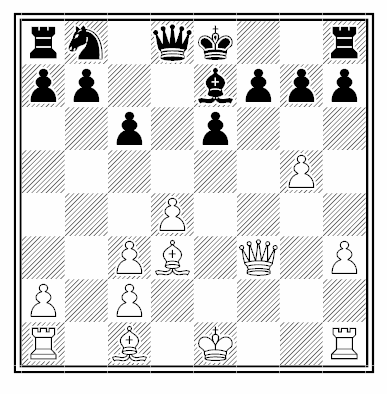
I got the name of this post from the Dylan song "One too many mornings" from his "The Times They Are a-Changin'" album in 1964. I wonder if Diemer ever heard of Bob Dylan and what he thought of this new kind of music.
In any case, yesrreday evening I was humiliated in a speed game in my local chess club - too many mistakes in a mere 16 moves costs me dearly.
1.d4 d5 2.e4 dxe4 3.Nc3 Nf6 4.f3 exf3 5.Nxf3 Bg4 6.h3 Bxf3 7.Qxf3 c6 8.g4 Nd5 (diagram)
The correct move here is 9.Bd3, with a nice white lead. However, without thinking at all, I played the inferior 9.Bc4 ( mistake #1 ).
9.Bc4 e6 10.Rf1 f6
Despite my first mistake, white still has the edge.
11.Bd2
Not optimal, but wont classify as a mistake.
11...Bb4 12.000 Nxc3 (diagram)
I now played 13.bxc3 -bad idea. the simple 13.Bxc3 would have brought a great lead due to black's fragile pawn structure ( mistake #2 )
13.bxc3 Ba3 14.Kb1 Qb6 15.Bb3 a5 (diagram)
After a (short) thought, I moved 16.d5?? now, as I was planning for Be3 on the next move, chasing away the queen and thus saving my bishop from entrapment. However, the simple c5 will block the bishop.... I should have played 16.g5 here, opening many lines with favourable complications.
I wont give the remainder of the game after my third horrible mistake 16.d5 - there might be children reading this blog...
Lesson learned - take your time to think and play the best moves, even when playing at a speedy tempo. Otherwise, you risk being slaughtered after three mistakes in only 16 moves.
Showing posts with label Teichmann Exchange. Show all posts
Saturday, June 6, 2015
Sunday, October 26, 2014
Can black hold in the Teichmann Exchange ?
My stats indicate I get the Teichmann Exchange most often. I dont know why, because the white attack is simple and fast. But the defender thinks that, by exchanging the knight on f3, he is one piece closer to a winning end game. Things are not so simple however as white has nice attacking chances.
However, there is one line that always bothered me :
1.d4 d5 2.e4 dxe4 3.Nc3 Nf6 4.f3 exf3 5.Nxf3 Bg4 6.h3 Bxf3 7.Qxf3 c6 8.g4 Qxd4
Blacks grab another pawn : "a pawn is a pawn"
9.Be3 Qb4
moving away from the file where it comes under attack of the rook
10.0-0-0 (diagram)
10...e6 is now the best defending move, even if 10...Nbd7 has to be respected.
10...e6 11.g5 Nd5 12.Bd4 (diagram)
White has moved his blacksquared bishop to a great diagonal. Thinsg are getting complicated for black !
12...Nbd7
Only move
13.h4 (diagram)
Let's see what black is up to. 13.Kb1 is also possible, but that is not the kind of move a gambiteer likes to play.
Let's assess this position
a/ 13...Be7 14.Bxg7 Rg8 15.Nxd5 cxd5 16.Bc3 Qa4 17.Bd3 and white has an obvious advantage (+)
b/ 13...Rg8 14.Bh3 (+)
c/ 13...f6 14.Bh3 (+)
d/ 13...f5 14.gxf5 Nxf6 15.Bh3 (+)
e/ 13...0-0-0 14.Qxf7 Qe7 15.Qf3 (+=)
f/ 13...Bd6 14.a3
...f1/ 14...Bf4+ 15.Kb1 Qa5 16.Nxd5 Qxd5 17.Qxf4 Qxh1 18.Be2 (++)
...f2/ 14...Qa5+ 15.Bxg7 Rg8 16.Nxd5
......f2a/ 16...cxd5 17.Bc3 (+=)
......f2b/ 16...Rxg7 17.b4 Qd8 18.Nf4 (+=)
g/ 13...Qd6 14.Kb1
...g1/ 14...Qf4 15.Qe2 (+=)
...g2/ 14...0-0-0 15.Bg2 (=)
...g3/ 14...c5 15.Nxd5 (=)
...g4/ 14...e5 15.Ne4 (+=)
So the unimaginable has become reality - there are a few lines that give black equality in the Teichmann Exchange !!
However, there is one line that always bothered me :
1.d4 d5 2.e4 dxe4 3.Nc3 Nf6 4.f3 exf3 5.Nxf3 Bg4 6.h3 Bxf3 7.Qxf3 c6 8.g4 Qxd4
Blacks grab another pawn : "a pawn is a pawn"
9.Be3 Qb4
moving away from the file where it comes under attack of the rook
10.0-0-0 (diagram)
10...e6 is now the best defending move, even if 10...Nbd7 has to be respected.
10...e6 11.g5 Nd5 12.Bd4 (diagram)
White has moved his blacksquared bishop to a great diagonal. Thinsg are getting complicated for black !
12...Nbd7
Only move
13.h4 (diagram)
Let's see what black is up to. 13.Kb1 is also possible, but that is not the kind of move a gambiteer likes to play.
Let's assess this position
a/ 13...Be7 14.Bxg7 Rg8 15.Nxd5 cxd5 16.Bc3 Qa4 17.Bd3 and white has an obvious advantage (+)
b/ 13...Rg8 14.Bh3 (+)
c/ 13...f6 14.Bh3 (+)
d/ 13...f5 14.gxf5 Nxf6 15.Bh3 (+)
e/ 13...0-0-0 14.Qxf7 Qe7 15.Qf3 (+=)
f/ 13...Bd6 14.a3
...f1/ 14...Bf4+ 15.Kb1 Qa5 16.Nxd5 Qxd5 17.Qxf4 Qxh1 18.Be2 (++)
...f2/ 14...Qa5+ 15.Bxg7 Rg8 16.Nxd5
......f2a/ 16...cxd5 17.Bc3 (+=)
......f2b/ 16...Rxg7 17.b4 Qd8 18.Nf4 (+=)
g/ 13...Qd6 14.Kb1
...g1/ 14...Qf4 15.Qe2 (+=)
...g2/ 14...0-0-0 15.Bg2 (=)
...g3/ 14...c5 15.Nxd5 (=)
...g4/ 14...e5 15.Ne4 (+=)
So the unimaginable has become reality - there are a few lines that give black equality in the Teichmann Exchange !!
Thursday, March 20, 2014
Looking for aggressive lines in the Teichmann Exchange
Last weekend, I faced a Teichmann Exchange but failed to find the correct line.
1.d4 d5 2.e4 dxe4 3.Nc3 Nf6 4.f3 exf3 5.Nxf3 Bg4 6.h3 Bxf3 7.Qxf3 c6 8.g4 e6 9.g5 Nd5 10.Bd3 Be7 11.h4 Qb6 (diagram)
I had played this opponent before, so I guess he was well prepared to play this line. I played 12.Bd2 Nd7 13.0-0-0 and I found myself in a lost position after 13...Qxd4. With two pawns down, I realised I had nothing - and indeed I went down the drain quickly.
So what should I play here ?
12.a3 is countered by 12...Nd7, and after 13.Bd2, white has lost one move compared to the immediate 12.Bd2.
12.Nxd5 cxd5 13.c3 is good for black, I think black can castle safely as the white queen cannot attack anymore via square e4, eg 13...0-0 14.h5 Nd7 (=+)
12.Rf1 is also no good as the simple 12...Qxd4 13.Qxf7+ Kd7 14.Qf2 Qxf2 leaves beaves white one pawn down without compensation.
So the only option for white to mplay for an advantage is 12.Bd2 (diagram), as I played in my game.
Black's options include
a/ 12...Qxd4 13.Nxd5
...a1/ 13...Qxd5 14.Be4 Qc4 15.0-0-0 Qxa2 16.Bc3 (=) (diagram below)
...a2/ 13...cxd5 14.Bc3 (+=)
b/ 12...Nd7 13.Nxd5
...b1/ 13...cxd5 14.0-0-0 (=)
...b2/ 13...exd5 14.0-0-0 (+=)
c/ 12...Nxc3 13.bxc3 (+=)
d/ 12...Nb4 13.Be4 (+=)
e/ 12...0-0 13.Qe4 g6 14.h5 (+)
f/ 12...f5 13.gxf6 (+=)
h/ 12...Na6 13.Rf1 (=)
The position in line a1 is interesting. White has sacrificed half of his army, whilst black only has developed his queen.
1.d4 d5 2.e4 dxe4 3.Nc3 Nf6 4.f3 exf3 5.Nxf3 Bg4 6.h3 Bxf3 7.Qxf3 c6 8.g4 e6 9.g5 Nd5 10.Bd3 Be7 11.h4 Qb6 (diagram)
I had played this opponent before, so I guess he was well prepared to play this line. I played 12.Bd2 Nd7 13.0-0-0 and I found myself in a lost position after 13...Qxd4. With two pawns down, I realised I had nothing - and indeed I went down the drain quickly.
So what should I play here ?
12.a3 is countered by 12...Nd7, and after 13.Bd2, white has lost one move compared to the immediate 12.Bd2.
12.Nxd5 cxd5 13.c3 is good for black, I think black can castle safely as the white queen cannot attack anymore via square e4, eg 13...0-0 14.h5 Nd7 (=+)
12.Rf1 is also no good as the simple 12...Qxd4 13.Qxf7+ Kd7 14.Qf2 Qxf2 leaves beaves white one pawn down without compensation.
So the only option for white to mplay for an advantage is 12.Bd2 (diagram), as I played in my game.
Black's options include
a/ 12...Qxd4 13.Nxd5
...a1/ 13...Qxd5 14.Be4 Qc4 15.0-0-0 Qxa2 16.Bc3 (=) (diagram below)
...a2/ 13...cxd5 14.Bc3 (+=)
...a3/ 13...exd5 14.0-0-0 (+=)
b/ 12...Nd7 13.Nxd5
...b1/ 13...cxd5 14.0-0-0 (=)
...b2/ 13...exd5 14.0-0-0 (+=)
d/ 12...Nb4 13.Be4 (+=)
e/ 12...0-0 13.Qe4 g6 14.h5 (+)
f/ 12...f5 13.gxf6 (+=)
h/ 12...Na6 13.Rf1 (=)
The position in line a1 is interesting. White has sacrificed half of his army, whilst black only has developed his queen.
White can unleash dangerous attacks in this line. Black's best try is 16...Nd7 17.Bxg7 Rg8 18.Rxd7!!! (diagram) with a complicated game.
So dont dispair if your opponent makes great moves - the Blackmar Diemer gambit contains winning sacrifices in every line !
Monday, September 23, 2013
Expert knowledge is absolutely necessary to win
I managed to secure a draw yesterday against a Teichmann Excehnge defense. My opponent did not play the strongest move, but I was unable to benefit from it, and i left him off the hook. So my advise to every gambiteer : learn the theory lines well - it will bring you many rewards.
Guido De Bouver - Bart Van Tichelen
1.d4 Nf6 2.f3 d5 3.e4 dxe4 4.Nc3 exf3 5.Nxf3 Bg4 6.h3 Bxf3 7.Qxf3 c6 8.g4 e6 9.g5 Nd5 10.Bd3 Nd7 (diagram)
I knew that this move is not so good - but I failed to take advantage of his move. Maybe I did not think well enough as my opponent had consumed already 55 minutes in this fiurst 10 moves. I used only 2 minutes and planned to start playing quickly to put extra pressure on my opponent's clock ( game was played under standard time control : 2 hours for 40 moves, then 1 hour knock out ).
Now playing quickly in this sort of positions might not be the best strategy...
11. Bd2 ??? (diagram)
Giving it away immediately. My plan was to castle queenside and continue play on f7.
But 11.00 would have crampled black's position ( see below ).
11...Qb6 12.Rf1 000 13.000 Bb4 14.Nxd5 Bxd2+ 15.Rxd2 exd5 16.Qxf7 Qxd4 17.Bxh7 (=) and the game was declared a draw quickly.
But let's look at the correct line after 11.00 (diagram)
a/ 11...f5 12.Nxd5
...a1/ 12...cxd5 13.Re1 (++)
...a2/ 12...exd5 13.Bxf5 (++)
b/ 11...f6 12.Re1
...b1/ 12...Nxc3 13.Rxe6+ (++)
...b2/ 12...Be7 13.Qh5+ (++)
...b3/ 12...Qe7 13.Nxd5 cxd5 14.Bf4 (+=)
c/ 11...Qe7 12.Nxd5 cxd5 13.Bf4 (diagram)
...c1/ 13...000 14.Kh1 (+=)
...c2/ 13...g6 14.Rae1 (+=)
...c3/ 13...Qb4 14.Bh2 (+=)
...c4/ 13...Rc8 14.Rae1 (+=)
So learn these theory lines and let your opponent's clock tick away these precious seconds !
Guido De Bouver - Bart Van Tichelen
1.d4 Nf6 2.f3 d5 3.e4 dxe4 4.Nc3 exf3 5.Nxf3 Bg4 6.h3 Bxf3 7.Qxf3 c6 8.g4 e6 9.g5 Nd5 10.Bd3 Nd7 (diagram)
I knew that this move is not so good - but I failed to take advantage of his move. Maybe I did not think well enough as my opponent had consumed already 55 minutes in this fiurst 10 moves. I used only 2 minutes and planned to start playing quickly to put extra pressure on my opponent's clock ( game was played under standard time control : 2 hours for 40 moves, then 1 hour knock out ).
Now playing quickly in this sort of positions might not be the best strategy...
11. Bd2 ??? (diagram)
Giving it away immediately. My plan was to castle queenside and continue play on f7.
But 11.00 would have crampled black's position ( see below ).
11...Qb6 12.Rf1 000 13.000 Bb4 14.Nxd5 Bxd2+ 15.Rxd2 exd5 16.Qxf7 Qxd4 17.Bxh7 (=) and the game was declared a draw quickly.
But let's look at the correct line after 11.00 (diagram)
a/ 11...f5 12.Nxd5
...a1/ 12...cxd5 13.Re1 (++)
...a2/ 12...exd5 13.Bxf5 (++)
...b1/ 12...Nxc3 13.Rxe6+ (++)
...b2/ 12...Be7 13.Qh5+ (++)
...b3/ 12...Qe7 13.Nxd5 cxd5 14.Bf4 (+=)
c/ 11...Qe7 12.Nxd5 cxd5 13.Bf4 (diagram)
...c1/ 13...000 14.Kh1 (+=)
...c2/ 13...g6 14.Rae1 (+=)
...c3/ 13...Qb4 14.Bh2 (+=)
...c4/ 13...Rc8 14.Rae1 (+=)
So learn these theory lines and let your opponent's clock tick away these precious seconds !
Saturday, February 2, 2013
Even weaker moves sometimes win
My opponent yesterday evening tried a Teichmann Exchange against me - and guess what - I had covered the line already in an earlier post. And guess another thing - I forgot about it ! But luckily I was able to pull off a nice attack, resulting in a nice win.
Guido De Bouver - Velibor Novakovic
1.d4 d5 2.e4 dxe4 3.Nc3 Nf6 4.f3 exf3 5.Nxf3 Bg4 6.h3 Bxf3 7.Qxf3 c6 8.g4 e6 9.g5 Nd5 10.Bd3 Be7 11.h4 Nd7 (diagram)
I covered this position in an earleir post "Black's difficult Teichmann Exchange defense" in May 2011. In there, I suggested 12.Nxd5, leading to an equal game.
12.Bd2 N7b6 13.000 Nxc3 14.Bxc3 Nd5 (diagram)
14...Qd5 would have been better, as the gambitplayer is not in a position to exchange queens.
15.Rdf1 00
Black is forced to castle into it
16.Qe4 (diagram)
An important move that appears frequently in white's attack in the Teichmann Exchange. It forces black to create a weakness.
16...g6 17.Bd2 Nb4 18.Bc4 Nd5 19.Kb1
A preparation move, so that the balck queen will not be able to check on g5.
19...b5 20.h5 (diagram)
Not so good. 20.Bd3 would have given me a decent advantage. But my move atatcks the black king at the expense of a piece - most chess players start makinmg mistakes when their king is attacked this way.
20....Bxg5 ?? 21.hxg6 1-0
So we see that Blackmar Diemer gambiteers dont necessarily have to play the best moves to create dispair in the defending ranks.
Guido De Bouver - Velibor Novakovic
1.d4 d5 2.e4 dxe4 3.Nc3 Nf6 4.f3 exf3 5.Nxf3 Bg4 6.h3 Bxf3 7.Qxf3 c6 8.g4 e6 9.g5 Nd5 10.Bd3 Be7 11.h4 Nd7 (diagram)
I covered this position in an earleir post "Black's difficult Teichmann Exchange defense" in May 2011. In there, I suggested 12.Nxd5, leading to an equal game.
12.Bd2 N7b6 13.000 Nxc3 14.Bxc3 Nd5 (diagram)
14...Qd5 would have been better, as the gambitplayer is not in a position to exchange queens.
15.Rdf1 00
Black is forced to castle into it
16.Qe4 (diagram)
An important move that appears frequently in white's attack in the Teichmann Exchange. It forces black to create a weakness.
16...g6 17.Bd2 Nb4 18.Bc4 Nd5 19.Kb1
A preparation move, so that the balck queen will not be able to check on g5.
19...b5 20.h5 (diagram)
Not so good. 20.Bd3 would have given me a decent advantage. But my move atatcks the black king at the expense of a piece - most chess players start makinmg mistakes when their king is attacked this way.
20....Bxg5 ?? 21.hxg6 1-0
So we see that Blackmar Diemer gambiteers dont necessarily have to play the best moves to create dispair in the defending ranks.
Wednesday, January 16, 2013
Grabbing it all
Last sunday, my opponent tried to eat all the pawns that were offered to him – but nearly choked of indigestion.
Guido De Bouver . Marc Moors
1.d4 d5 2.e4 dxe4 3.Nc3 Nf6 4.f3 exf3 5.Nxf3 Bg4 6.h3 Bxf3 7.Qxf3 c6 8.g4 Qxd4 9.Be3 Qd7 (diagram)
A rather strange retreat. With the pawn on c6, d7 seemed liked the perfect spot for the knight.
10.Rd1
Not the
strongest move. 10.Bd3 followed by queenside castling is stronger.
10…Qc7 11.g5
Nd5
11…Nfd7 also
seems possible.
12.Rxd5 ?!
(diagram)
I was throwing
it all in here. 12.Nxd5 was certainly better and leads to an equal position
Leads to disaster, 13…Qd7 was the only way for black to take the advantage.
14.Bb5+
Unfortunately, I missed the tactical shot with 14.Nb6 axb6 15.Qxb7 with a clear white advantage and the game ended in a draw.
But let’s return to white’s best continuation after 9…Qd7, 10.Bd3 (diagram)
a/ 10…e6 11.000
…a1/ 11…Be7 12.Rhf1 (+=)
…a2/ 11…Bd6 12.g5 Nd5 13.Bd4 (=)
…a3/ 11…Bb4 12.Bh6 (=)
…a4/ 11…Nd5 12.Bd4 (=)
b/ 10...Nd5 11.000
...b1/ 11...e6 12.Bd4 (=)
...b2/ 11...Nxc3 12.Bc4 (+=)
...b3/ 11...Nxe3 12.Bf5 (+=)
c/ 10...h6 11.000 e6 12.Ne4 (=)
So we see black has to be carefull and certainly cannot force an advantage, despite being two pawns up.
Thursday, May 31, 2012
The delayed Ryder : final chapter
I have been covering the delayed Ryder, occuring after 1.d4 d5 2.e4 dxe4 3.Nc3 Nf6 4.f3 exf3 5.Nxf3 Bg4 6.h3 Bxf3 7.Qxf3 c6 8.g4 Qxd4 9.Be3 rather extensively.
My blog "What the hec ?" covered the line after 9...Qe5. "Nb5 - it must be right" discussed 9...Qb4 whilst "A killer move in the delayed Ryder" discussed 9...Qd6.
This post focuses on 9...Qd8 (diagram) and white's obvious continuation 10.g5. Black only has 10...Nd5 and 10...Nfd7 as 10...Ng8 looses quickly (++)
a/ 10...Nd5 11.000 e6 12.Nxd5
...a1/ 12...cxd5 13.Bb5+
......a1a/ 13...Nc6 14.c4 (=)
......a1b/ 13...Nd7 14.Rhf1 Qe7 15.Kb1 (+)
...a2/ 12...exd5 13.Re1 (+)
b/ 10...Nfd7 11.000
...b1/ 11...e6 12.Be2 (+=)
...b2/ 11...g6 12.Bc4 (++)
...b3/ 11...Qc7 12.Kb1 (+=)
...b4/ 11...Qa5 12.Qg3 (+=)
So it seems that 9...Qd8 is not so bad after all - the line 10.g5 Nd5 11.000 e6 12.Nxd5 cxd5 13.Bb5+ Nc6 14.c4 (diagram) offers only equality. Black has two pawns, but is far behind in material. However, black may restore equality after 14...Be7 15.cxd5 exd5.
Houdini now suggests 18.Kb1 (diagram) with equality.
Talking about a disappointment !
My blog "What the hec ?" covered the line after 9...Qe5. "Nb5 - it must be right" discussed 9...Qb4 whilst "A killer move in the delayed Ryder" discussed 9...Qd6.
This post focuses on 9...Qd8 (diagram) and white's obvious continuation 10.g5. Black only has 10...Nd5 and 10...Nfd7 as 10...Ng8 looses quickly (++)
a/ 10...Nd5 11.000 e6 12.Nxd5
...a1/ 12...cxd5 13.Bb5+
......a1a/ 13...Nc6 14.c4 (=)
......a1b/ 13...Nd7 14.Rhf1 Qe7 15.Kb1 (+)
...a2/ 12...exd5 13.Re1 (+)
b/ 10...Nfd7 11.000
...b1/ 11...e6 12.Be2 (+=)
...b2/ 11...g6 12.Bc4 (++)
...b3/ 11...Qc7 12.Kb1 (+=)
...b4/ 11...Qa5 12.Qg3 (+=)
So it seems that 9...Qd8 is not so bad after all - the line 10.g5 Nd5 11.000 e6 12.Nxd5 cxd5 13.Bb5+ Nc6 14.c4 (diagram) offers only equality. Black has two pawns, but is far behind in material. However, black may restore equality after 14...Be7 15.cxd5 exd5.
Houdini now suggests 18.Kb1 (diagram) with equality.
Talking about a disappointment !
Friday, April 20, 2012
A (very) thematic sacrifice
In my book "Attack with the Blackmar Diemer", I have covered the line in the Seidel hall attack 1.d4 d5 2.e4 dxe4 3.Nc3 Nf6 4.f3 exf3 5.Nxf3 Bg4 6.h3 Bxg4 7.Qxf3 c6 8.g4 e6 9.g5 Nd5 10.Bd3 Nxc3 11.bxc3 ( In an earlier blog, I indicated that 10...Nxc3 could be answered potentially by 11.00 ) Be7.
In my book, I suggested the thematic sacrifice 12.00 00 13.Bxh7+ Kxh7 14.Qh5+ Kg8 15.Rxf7 ( diagram ), but it seems black can escape with a draw after 15...Qa5 as white has no other chioce than accepting the draw with 16.Rxg7+ Kxg7 17.Qh6+
If white wants to play for a win, 12.00 00 13.Rb1 ( diagram ) might offer the best choices. But then the same sacrifice is again available in all lines.
a/ 13...b6 14.Bxh7+ Kxh7 15.Qh5+ Kf8 18.Rxf7 and black's strongest move ( Qa5 ) is not available anymore as the b6 pawn is in the way (+=)
b/ 13...b5 14.Bxh7+ Kxh7 15.Qh5+ Kg8 16.Rxf7 (+)
c/ 13...Qc8 14.Bxh7+ Kxh7 15.Qh5+ Kg8 16.Rxf7 (++)
d/ 13...Qd7 14.Bxh7+ Kxh7 15.Qh5+ Kg8 16.Rxf7 (++)
e/ 13...Qc7 14.Bxh7+ Kxh7 15.Qh5+ Kg8 16.Rf4 ( the sacrifice on f7 is not possible as white can deliver check on g3 ) and white has a draw. Obviously, 14.Bf4 is better than 14.Bxh7+, but it shows that the sacrifice is possible in all lines.
SO it seems like this is a very usefull sacrifice to be remembered !
In my book, I suggested the thematic sacrifice 12.00 00 13.Bxh7+ Kxh7 14.Qh5+ Kg8 15.Rxf7 ( diagram ), but it seems black can escape with a draw after 15...Qa5 as white has no other chioce than accepting the draw with 16.Rxg7+ Kxg7 17.Qh6+
If white wants to play for a win, 12.00 00 13.Rb1 ( diagram ) might offer the best choices. But then the same sacrifice is again available in all lines.
a/ 13...b6 14.Bxh7+ Kxh7 15.Qh5+ Kf8 18.Rxf7 and black's strongest move ( Qa5 ) is not available anymore as the b6 pawn is in the way (+=)
b/ 13...b5 14.Bxh7+ Kxh7 15.Qh5+ Kg8 16.Rxf7 (+)
c/ 13...Qc8 14.Bxh7+ Kxh7 15.Qh5+ Kg8 16.Rxf7 (++)
d/ 13...Qd7 14.Bxh7+ Kxh7 15.Qh5+ Kg8 16.Rxf7 (++)
e/ 13...Qc7 14.Bxh7+ Kxh7 15.Qh5+ Kg8 16.Rf4 ( the sacrifice on f7 is not possible as white can deliver check on g3 ) and white has a draw. Obviously, 14.Bf4 is better than 14.Bxh7+, but it shows that the sacrifice is possible in all lines.
SO it seems like this is a very usefull sacrifice to be remembered !
Thursday, February 23, 2012
Demolition moves !
I always found black's reply 8...h6 ( diagram ) in the Hara Kiri attack in the Teichmann Exchange an interesting defense. The move prevents 9.g5, dislodging the black horseman from its preferred location. But then again, apart from preventing white to do something, it does nothing but yielding the initiative to white.
In my book, I suggested white to continue 9.Bf4, but now I realise this is not sufficient for the attack, as the continuation 9...Qxd4 10.Nb5 cxb5 11.Qxb7 Qe4+ 12.Qxe4 Nxe4 13.Bg2 Nd7 14.Bxe4 Rc8 15.000 brings no advantage for the attacker. White has the bishop pair, but black has a solid pawn. Too many pieces have been exchanged however to give white winning chances, so a draw seems a logical result.
Christoph Scheerer lists 9.Be3, but I also doubt this is sufficient, since 9...e6 10.Bd3 Bb4 is also not great for the attacker. Christoph now provides 11.00, also backed up by a Peter Leisebein correspondence game. But the line 11...Qe7 12.a3 Bd6 13.b4 a6 seems to be inferior to 13...Nbd7, with black having far the better game.
So I believe 9.Bd2 is best as it i) takes the bite out of Bb4 and ii) allows castling queenside, even if black grabs another pawn.
a/ 9...Qxd4 10.000
...a1/ 10...Qb6 11.h4 Nbd7 12.Bh3 (=)
...a2/ 10...e6 11.Bxh6 Qb6 12.Be3 Bc5 13.Bd2 (=)
...a3/ 10...Qc5 11.Nb5 Na6 12.Be3 (+=)
...a4/ 10...Qe5 11.Nb5 Na6 12.Bf4 (+=)
...a5/ 10...Nbd7 11.Bxh6 (+=)
b/ 9...e6 10.000
...b1/ 10...Qxd4 (=) ( cfr a2 above )
...b2/ 10...Bb4 11.Kb1 (=)
...b3/ 10...Be7 11.Kb1 (+=)
...b4/ 10...Bd6 11.h4 (+=)
...b5/ 10...Nbd7 11.h4 (=)
...b6/ 10...Qb6 11.Be1 (=)
c/ 9...Qb6 10.000
...c1/ 10...e6 (=) ( cfr b6 above )
...c2/ 10...Nbd7 11.Be2 (+=)
d/ 9.Nbd7 10.000 (=)
...d1/ 10...e6 (=) ( cfr b5 above )
...d2/ 10...Nb6 11.a3 (=)
...d3/ 10...Qb6 (+=) ( cfr c2 above )
More work is needed on this line, but I believe 9.Bd2 it is a better alternative than 9.Bf4 or 9.Be3.
In my book, I suggested white to continue 9.Bf4, but now I realise this is not sufficient for the attack, as the continuation 9...Qxd4 10.Nb5 cxb5 11.Qxb7 Qe4+ 12.Qxe4 Nxe4 13.Bg2 Nd7 14.Bxe4 Rc8 15.000 brings no advantage for the attacker. White has the bishop pair, but black has a solid pawn. Too many pieces have been exchanged however to give white winning chances, so a draw seems a logical result.
Christoph Scheerer lists 9.Be3, but I also doubt this is sufficient, since 9...e6 10.Bd3 Bb4 is also not great for the attacker. Christoph now provides 11.00, also backed up by a Peter Leisebein correspondence game. But the line 11...Qe7 12.a3 Bd6 13.b4 a6 seems to be inferior to 13...Nbd7, with black having far the better game.
So I believe 9.Bd2 is best as it i) takes the bite out of Bb4 and ii) allows castling queenside, even if black grabs another pawn.
a/ 9...Qxd4 10.000
...a1/ 10...Qb6 11.h4 Nbd7 12.Bh3 (=)
...a2/ 10...e6 11.Bxh6 Qb6 12.Be3 Bc5 13.Bd2 (=)
...a3/ 10...Qc5 11.Nb5 Na6 12.Be3 (+=)
...a4/ 10...Qe5 11.Nb5 Na6 12.Bf4 (+=)
...a5/ 10...Nbd7 11.Bxh6 (+=)
b/ 9...e6 10.000
...b1/ 10...Qxd4 (=) ( cfr a2 above )
...b2/ 10...Bb4 11.Kb1 (=)
...b3/ 10...Be7 11.Kb1 (+=)
...b4/ 10...Bd6 11.h4 (+=)
...b5/ 10...Nbd7 11.h4 (=)
...b6/ 10...Qb6 11.Be1 (=)
c/ 9...Qb6 10.000
...c1/ 10...e6 (=) ( cfr b6 above )
...c2/ 10...Nbd7 11.Be2 (+=)
d/ 9.Nbd7 10.000 (=)
...d1/ 10...e6 (=) ( cfr b5 above )
...d2/ 10...Nb6 11.a3 (=)
...d3/ 10...Qb6 (+=) ( cfr c2 above )
More work is needed on this line, but I believe 9.Bd2 it is a better alternative than 9.Bf4 or 9.Be3.
Saturday, January 28, 2012
Time to cash in ?
It is often so hard for Blackmar Diemer gambiteers to decide when to cash in. White sacrifices a pawn for development in the opening, but needs to work hard to show something tangible. Often comes a time when white can regain the sacrificed material, mostly at the expense of exchanging some pieces. Typically this exchange results in matching the black development to the attacker's.
But should white allow this equalising process when he has the opportunity ? Or should the attcker continue the attack at all cost, burning all of his bridges ? This is truely a difficult choice, but decides on winning or loosing.
Yesterday evening I was confronted with this choice. I could have cashed in on move 12, but choose to continue the attack - I was duely punished.
Guido De Bouver - Van Bladel
1.d4 d5 2.e4 dxe4 3.Nc3 Nf6 4.f3 exf3 5.Nxf3 Bg4 6.h3 Bxf3 7.Qxf3 c6 8.g4
The Seidel-Hall attack in the Teichmann Exchange defense.
8...Nd5 ?!
The normal continuation is 8...e6 9.g5 Nd5. White wins a tempo compared to this normal continuation as white has not wasted g5 to dislodge the black knight.
9.Bd3 e6 10.00 Qf6 11.Nxd5 cxd5
The dilemma occurs. Cash in with 12.Qxf6 gxf6 13.Rxf6 Bg7 14.Rf4 and white has a small advantage as the development lead has not yet completely evaporated.
I choose to continue the attack and sacrifce yet another pawn.
12.Qg3
Inviting black to capture on d4, after which the dark squared bishop can come into play quickly.
12...Qxd4+ 13.Be3 Qb4 14.Rf4 Qd6 15.Raf1 f6 16.Qh4
16...Kd8
A strange move. Black prepares g5. 17.Rxf6 would have given me the better game, but I failed to see the consequences of 17...Be7 18.Rf8+ Rxf8 19.Rxf8+ Kd7 20.Rf7 Nc6 with an even game.
17.Qh5 Nd7 18.Kg2
My rook on f4 was pinned as this would have given black the queen's check on g3, so I decided to remove the pin.
18...Ne5 19.Bb5 g6 20.Qh4
Black could now have settled matters with 20...g5 as the threat on d8 can be disregarded, eg 21.Qh5 gxf4 22.Qd8+ Kc7 23.Qxa8 fxe3 and black is too many pieces ahead.
20...Be7 21.Rf2 ??
The loosing move in this hugely complex position. 20.Rxf6 would have given me decent chances. The remainder of the game resembles a torture.
21...g5 22.Qh6 Ng6 23.Qg7 Nh4+ 24.Kh1 Kc7 25.Rxf6
Too little, too late. So far, I had spent 1 hr 45 hours of thinking time and had only 15' left for the remaining 16 moves.
25...Rag8
26.Qf7
Loosing, but also 26.Qxe7+ Qxe7 27.Rf7 Qxe7 28.Rxf7+ Kb8 29.Bd4 Rf8 is not sufficient
26...Rf8 27.Qg7 Rhg8 28.Qxh7 Rh8
Great play by my opponent, opening the h file.
29.Qg7 Nf5!!
and I duly resigned here 0-1
I could have cashed in on move 12, but choose to sacrifce yet another pawn. Wrong choice - shit happens...
But should white allow this equalising process when he has the opportunity ? Or should the attcker continue the attack at all cost, burning all of his bridges ? This is truely a difficult choice, but decides on winning or loosing.
Yesterday evening I was confronted with this choice. I could have cashed in on move 12, but choose to continue the attack - I was duely punished.
Guido De Bouver - Van Bladel
1.d4 d5 2.e4 dxe4 3.Nc3 Nf6 4.f3 exf3 5.Nxf3 Bg4 6.h3 Bxf3 7.Qxf3 c6 8.g4
The Seidel-Hall attack in the Teichmann Exchange defense.
8...Nd5 ?!
The normal continuation is 8...e6 9.g5 Nd5. White wins a tempo compared to this normal continuation as white has not wasted g5 to dislodge the black knight.
9.Bd3 e6 10.00 Qf6 11.Nxd5 cxd5
The dilemma occurs. Cash in with 12.Qxf6 gxf6 13.Rxf6 Bg7 14.Rf4 and white has a small advantage as the development lead has not yet completely evaporated.
I choose to continue the attack and sacrifce yet another pawn.
12.Qg3
Inviting black to capture on d4, after which the dark squared bishop can come into play quickly.
12...Qxd4+ 13.Be3 Qb4 14.Rf4 Qd6 15.Raf1 f6 16.Qh4
16...Kd8
A strange move. Black prepares g5. 17.Rxf6 would have given me the better game, but I failed to see the consequences of 17...Be7 18.Rf8+ Rxf8 19.Rxf8+ Kd7 20.Rf7 Nc6 with an even game.
17.Qh5 Nd7 18.Kg2
My rook on f4 was pinned as this would have given black the queen's check on g3, so I decided to remove the pin.
18...Ne5 19.Bb5 g6 20.Qh4
Black could now have settled matters with 20...g5 as the threat on d8 can be disregarded, eg 21.Qh5 gxf4 22.Qd8+ Kc7 23.Qxa8 fxe3 and black is too many pieces ahead.
20...Be7 21.Rf2 ??
The loosing move in this hugely complex position. 20.Rxf6 would have given me decent chances. The remainder of the game resembles a torture.
21...g5 22.Qh6 Ng6 23.Qg7 Nh4+ 24.Kh1 Kc7 25.Rxf6
Too little, too late. So far, I had spent 1 hr 45 hours of thinking time and had only 15' left for the remaining 16 moves.
25...Rag8
26.Qf7
Loosing, but also 26.Qxe7+ Qxe7 27.Rf7 Qxe7 28.Rxf7+ Kb8 29.Bd4 Rf8 is not sufficient
26...Rf8 27.Qg7 Rhg8 28.Qxh7 Rh8
Great play by my opponent, opening the h file.
29.Qg7 Nf5!!
and I duly resigned here 0-1
I could have cashed in on move 12, but choose to sacrifce yet another pawn. Wrong choice - shit happens...
Thursday, September 8, 2011
What the hec ?
I played a nice game yesterday. My opponent was playing comfortably and suddenly his world collapsed.
1.d4 d5 2.e4 dxe4 3.Nc3 Nf6 4.f3 exf3 5.Nxf3 Bg4 6.h3 Bxf3 7.Qxf3
The Teichmann Exchange defense
7...c6 8.g4 Qxd4 9.Be3
Black grabs a second pawn, realising that white has a terrible initiative.
9...Qe5 10.000 e6 11.g5
The thematic advance is here correct as well.
11...Nd5
Wrong - but what human is able to predict the outcome of the resulting complications ?
12.Nxd5 cxd5
12...exd5 is visually worse, as the queen gets cornered, eg 13.Bf4 Qe6 14.Qg3 (++)
13.Bf4 Qe4 14.Qxe4 dxe4 15.Bxb8
Removing black's possibility to block the bishop's check. Now black's world collapses.
15...Rxb8 16.Bb5+ Ke7 17.Rd7+ Ke8 18.Rxb7+
18.Rhd1 would have been even stronger, but black wisely resigned here.
What a line ! Black's 11th move was bad and leads to a forced loss, but the defender did not realise it untill move 16.
11...Nfd7 would have been stronger, with white having only a small lead after 12.Be2
1.d4 d5 2.e4 dxe4 3.Nc3 Nf6 4.f3 exf3 5.Nxf3 Bg4 6.h3 Bxf3 7.Qxf3
The Teichmann Exchange defense
7...c6 8.g4 Qxd4 9.Be3
Black grabs a second pawn, realising that white has a terrible initiative.
9...Qe5 10.000 e6 11.g5
The thematic advance is here correct as well.
11...Nd5
Wrong - but what human is able to predict the outcome of the resulting complications ?
12.Nxd5 cxd5
12...exd5 is visually worse, as the queen gets cornered, eg 13.Bf4 Qe6 14.Qg3 (++)
13.Bf4 Qe4 14.Qxe4 dxe4 15.Bxb8
Removing black's possibility to block the bishop's check. Now black's world collapses.
15...Rxb8 16.Bb5+ Ke7 17.Rd7+ Ke8 18.Rxb7+
18.Rhd1 would have been even stronger, but black wisely resigned here.
What a line ! Black's 11th move was bad and leads to a forced loss, but the defender did not realise it untill move 16.
11...Nfd7 would have been stronger, with white having only a small lead after 12.Be2
Monday, August 15, 2011
Nb5 - it must be right !
last post discussed the line 5...Bg4 6.h3 Bxg4 7.Qxf3 c6 8.g4 Qxd4 9.Be3 Qd6.
It seemed that white can equalise rather easily with 10.g4, but getting an advantage seemed unlikely for either player.
Black can also play more ambituously 9...Qb4 10.000
White's pieces are all ready for the kill, but the black prey keeps on struggling...
a/ 10...Nbd7 11.g5 Ne5 12.Qg3 Nfd7 13.Bd4
...a1/ 13...Qd6 14.Ne4 (+=)
...a2/ 13...Qa5 14.Nb5 (My loverboy - see my previous post) (+=)
...a3/ 13...f6 14.h4 (+=)
...a4/ 13...Nc4 14.Bxc4 Qxc4 15.Qc7 (++)
...a5/ 13...Ng6 14.Qc7 (+)
b/ 10...h6 11.Nb5 (Ahhhh, finally... ) Na6 12.Nxa7
...b1/ 12...Qe4 13.Qxe4 Nxe4 14.Bg2 (+=)
...b2/ 12...Nb8 13.Nb5 (once again) Na6 14.Bd4 (+=)
...b3/ 12...Nc7 13.Nxc6 Qe4 14.Qxe4 Nxe4 15.Na7 (+=)
...b4/ 12...e6 13.Bxa6 Bc5 14.Bxc5 Qxc5 15.Bxb7 (+=)
...b5/ 12...Qa4 13.Bb5 (wow...what a move...black's queen is kicked around all sides) (+)
c/ 10...Qa5 11.g5 Nfd7 12.Nb5 (yep - another appearance)
...c1/ 12...e6 13.Bd4 (+=)
...c2/ 12...cxb5 13.Qxb7 (++)
...c3/ 12...Ne5 13.Qf5 (++)
d/ 10...a6 (preventing Nb5) 11.g5 Nfd7 12.Be2
...d1/ 12...e6 13.Rhf1 (+)
...d2/ 12...Ne5 13.Qg3 (+=)
e/ 10...e6 (black's only good move ) 11.g5 ( diagram )
In my book "Attack with the Blackmar Diemer", I also recommended 11.Nb5, but this leads only to equality after 11...Qa5.
...e1/ 11...Nd5 12.Bd4 (=)
...e2/ 11...Nfd7 12.Bd4 (+=)
So we learn that black, despite his two pan advantage, can only obtain equality in only single line after his reckless pawn grab 5...Bg4 6.h3 Bxg4 7.Qxf3 c6 8.g4 Qxd4 9.Be3 Qb4 10.000. I never came across this move on a serious over-the-board game, but it occurs rather frequent in blitz.
It seemed that white can equalise rather easily with 10.g4, but getting an advantage seemed unlikely for either player.
Black can also play more ambituously 9...Qb4 10.000
White's pieces are all ready for the kill, but the black prey keeps on struggling...
a/ 10...Nbd7 11.g5 Ne5 12.Qg3 Nfd7 13.Bd4
...a1/ 13...Qd6 14.Ne4 (+=)
...a2/ 13...Qa5 14.Nb5 (My loverboy - see my previous post) (+=)
...a3/ 13...f6 14.h4 (+=)
...a4/ 13...Nc4 14.Bxc4 Qxc4 15.Qc7 (++)
...a5/ 13...Ng6 14.Qc7 (+)
b/ 10...h6 11.Nb5 (Ahhhh, finally... ) Na6 12.Nxa7
...b1/ 12...Qe4 13.Qxe4 Nxe4 14.Bg2 (+=)
...b2/ 12...Nb8 13.Nb5 (once again) Na6 14.Bd4 (+=)
...b3/ 12...Nc7 13.Nxc6 Qe4 14.Qxe4 Nxe4 15.Na7 (+=)
...b4/ 12...e6 13.Bxa6 Bc5 14.Bxc5 Qxc5 15.Bxb7 (+=)
...b5/ 12...Qa4 13.Bb5 (wow...what a move...black's queen is kicked around all sides) (+)
c/ 10...Qa5 11.g5 Nfd7 12.Nb5 (yep - another appearance)
...c1/ 12...e6 13.Bd4 (+=)
...c2/ 12...cxb5 13.Qxb7 (++)
...c3/ 12...Ne5 13.Qf5 (++)
d/ 10...a6 (preventing Nb5) 11.g5 Nfd7 12.Be2
...d1/ 12...e6 13.Rhf1 (+)
...d2/ 12...Ne5 13.Qg3 (+=)
e/ 10...e6 (black's only good move ) 11.g5 ( diagram )
In my book "Attack with the Blackmar Diemer", I also recommended 11.Nb5, but this leads only to equality after 11...Qa5.
...e1/ 11...Nd5 12.Bd4 (=)
...e2/ 11...Nfd7 12.Bd4 (+=)
So we learn that black, despite his two pan advantage, can only obtain equality in only single line after his reckless pawn grab 5...Bg4 6.h3 Bxg4 7.Qxf3 c6 8.g4 Qxd4 9.Be3 Qb4 10.000. I never came across this move on a serious over-the-board game, but it occurs rather frequent in blitz.
Monday, August 8, 2011
A killer move in the delayed Ryder
I admit - my recommendation on a line in the Teichmann Exhange was wrong. I had published the continuation 10.Nb5 in my book "Attack with the Blackmar Diemer" on the line 1.d4 d5 2.e4 dxe4 3.Nc3 Nf6 4.f3 exf3 5.Nxf3 Bg4 6.h3 Bxf3 7.Qxf3 c6 8.g4 Qxd4 9.Be3 Qd6.
I had given the continuation 10...Qd7 11.Rd1 Qc8 a small advantage as black - which is very correct - but now I realise that there are better moves than 10.Nb5.
Let's take the natural 10.g5 as a starter - if it weren't for the potential g5, why play g4 anyway ?
a/ 10...Nd5 11.000 e6 12.Bb5 !!
( The Killer move - it is very probable that the gambiteer will get his opponent thinking on that move ! It certainly puts pressure on the knight on d5 and the queen on d6, but is it correct ? )
..a1/ 12...Nd7 13.Nxd5
....a11/ 13...exd5 14.Bf4 Qc5 15.Rhe1+ Be7 16.Qe2 (=) and the initiative outweigh the pawns
....a12/ 13...cxd5 14.Rf1 +=
..a2/ 12...cxb5 13.Rf1 Qd7 14.Nxd5 exd5 15.Rxd5 Qe6 16.Rd4 Be7 17.Re4 Qxa2 18.Rxe7+ Kxe7 19.Qxb7+ Nd7 20.Bc5 Kd8 21.Re1 Qa1+ 22.Kd2 (=) resulting in a very unbalanced position
..a3/ 12...Be7 13.Nxd5 exd5 14.Rxd5 (=)
b/ 10...Nfd7 11.Bf4
..b1/ 11...Qe6+ 12.Be2 (=)
..b2/ 11...e5 12.Bd2 (=)
..b3/ 11...Qd4 12.Rh2 !! (=)
..b4/ 11...Ne5 12.Qg3 (=)
..b5/ 11...Qg6 12.000 (+=)
..b6/ 11...Qb4 12.000 (+=)
..b7/ 11...Qc5 12.000 (+=)
In addition, you might want to consider the simpler 10.Rd1, which might even be better than the crazy continuation described above.
I admit, my killer move does not win instantly - but hey, if you want to play it safe, play something quiter than the Blackmar Diemer !
I had given the continuation 10...Qd7 11.Rd1 Qc8 a small advantage as black - which is very correct - but now I realise that there are better moves than 10.Nb5.
Let's take the natural 10.g5 as a starter - if it weren't for the potential g5, why play g4 anyway ?
a/ 10...Nd5 11.000 e6 12.Bb5 !!
( The Killer move - it is very probable that the gambiteer will get his opponent thinking on that move ! It certainly puts pressure on the knight on d5 and the queen on d6, but is it correct ? )
..a1/ 12...Nd7 13.Nxd5
....a11/ 13...exd5 14.Bf4 Qc5 15.Rhe1+ Be7 16.Qe2 (=) and the initiative outweigh the pawns
....a12/ 13...cxd5 14.Rf1 +=
..a2/ 12...cxb5 13.Rf1 Qd7 14.Nxd5 exd5 15.Rxd5 Qe6 16.Rd4 Be7 17.Re4 Qxa2 18.Rxe7+ Kxe7 19.Qxb7+ Nd7 20.Bc5 Kd8 21.Re1 Qa1+ 22.Kd2 (=) resulting in a very unbalanced position
..a3/ 12...Be7 13.Nxd5 exd5 14.Rxd5 (=)
b/ 10...Nfd7 11.Bf4
..b1/ 11...Qe6+ 12.Be2 (=)
..b2/ 11...e5 12.Bd2 (=)
..b3/ 11...Qd4 12.Rh2 !! (=)
..b4/ 11...Ne5 12.Qg3 (=)
..b5/ 11...Qg6 12.000 (+=)
..b6/ 11...Qb4 12.000 (+=)
..b7/ 11...Qc5 12.000 (+=)
In addition, you might want to consider the simpler 10.Rd1, which might even be better than the crazy continuation described above.
I admit, my killer move does not win instantly - but hey, if you want to play it safe, play something quiter than the Blackmar Diemer !
Friday, June 10, 2011
The "bad" Bb4 - as opposed to the "good" Be7 in the Teichmann Exchange
Previous posts discussed the lines 10...Bd6 and 10...Be7 in the Seidel Hall line of the Teichmann Exchange, occuring after 1.d4 d5 2.e4 dxe4 3.Nc3 Nf6 4.f3 exf3 5.Nxf3 Bg4 6.h3 Bxf3 7.Qxf3 c6 8.g4 e6 9.g5 Nd5 10.Bd3
We learned that black faces an uphill struggle to obtain equality.
This current blog focuses on another variation, occuring after black's 10...Bb4.
The lines with black playing Bb4 are often condemned in the Blackmar Diemer theory, but are actually very hard to play against, as black might exchange a piece and comes closer to a potentially winning endgame.
11.Bd2 has some merit as it allows the standard attach Qe4 followed by h4 and h5 if black were so kind as to play 11...00, eg 11...00 12.Qe4 g6 13.h4 (diagram) 13...e5 (trying to open the e-file) 14.h5 and white is better, eg 14...exd4 15.hxg6 Re8 16.gxf7+ and white mates in 10.
The problem is that black can simply play a waiting move 11...Nd7 (instead of the committal 11...00) and white must declare his intentions first - with black getting the better play.
11.a3 is also insufficient, eg 11...Bxc3+ 12.bxc3 Nxc3 and there is no way to create an immediate threat to exploit the two pawn deficit, eg 13.00 00 14.Bxh7+ Kxh7 15.Qxc3 Nd7 and black is better
So 11.00 ( with the automatic reply 11...00 ) is actually forced for white, after which 12.Ne4 is the only move that does not permit the exchange of pieces. Black's bishop on b4 now seems ridiculous.
We learned that black faces an uphill struggle to obtain equality.
This current blog focuses on another variation, occuring after black's 10...Bb4.
The lines with black playing Bb4 are often condemned in the Blackmar Diemer theory, but are actually very hard to play against, as black might exchange a piece and comes closer to a potentially winning endgame.
11.Bd2 has some merit as it allows the standard attach Qe4 followed by h4 and h5 if black were so kind as to play 11...00, eg 11...00 12.Qe4 g6 13.h4 (diagram) 13...e5 (trying to open the e-file) 14.h5 and white is better, eg 14...exd4 15.hxg6 Re8 16.gxf7+ and white mates in 10.
The problem is that black can simply play a waiting move 11...Nd7 (instead of the committal 11...00) and white must declare his intentions first - with black getting the better play.
11.a3 is also insufficient, eg 11...Bxc3+ 12.bxc3 Nxc3 and there is no way to create an immediate threat to exploit the two pawn deficit, eg 13.00 00 14.Bxh7+ Kxh7 15.Qxc3 Nd7 and black is better
So 11.00 ( with the automatic reply 11...00 ) is actually forced for white, after which 12.Ne4 is the only move that does not permit the exchange of pieces. Black's bishop on b4 now seems ridiculous.
Wednesday, June 8, 2011
What the computer is playing against me
I am playing occasionaly on FICS under the account Ajaxke - my rating is quite low as my daughter ( 9 years old ) continuously plays under the same account.
Anyway, I was playing yesterday one of the Crafty clones and it was playing an interesting line against me. It did that again and agan, without spending any time, so I am pretty sure it must be preprogrammed.
I could not find the refutation over the board, so I decided to analyse it a bit better and came up with a nice advantage for white - but getting an advantage requires some great white moves !
Anyway, I was playing yesterday one of the Crafty clones and it was playing an interesting line against me. It did that again and agan, without spending any time, so I am pretty sure it must be preprogrammed.
I could not find the refutation over the board, so I decided to analyse it a bit better and came up with a nice advantage for white - but getting an advantage requires some great white moves !
Thursday, May 5, 2011
An alternative plan
Let's look at the Teichmann Exchange lines after 1.d4 d5 2.e4 dxe4 3.Nc3 Nf6 4.f3 exf3 5.Nxf3 Bg4 6.h3 Bxf3 7.Qxf3 c6 8.g4 e6 9.g5 Nd5 10.Bd3 Nxc3
White's normal plan is now to play 11.bxc3, followed by kingside castling. But there is a another move, eg 11.Rf1 !!
Defending f7 might not be black's best choice, as the prefered 11...Qc7 is answered by 12.Bf4, further winning time and space.
11...Qe7 12.bxc3 Black has blocked his bishop, whilst white cant castle anymore - who is better ? Houdini gives white a small plus after 12...Nd7 13.Kd1
11...Qd7 12.bxc3 with equality, eg 12...Bd6 13.h4 00 14.h5 (equal) or 12...Na6 13.Bf4 (tiny white advantage) or 12...c5 13.Bb2 (white is better).
Black might be willing to take more risk and counterattack with 11...Qxd4 12.Qxf7+ Kd8 13.Qxb7
A very complicated position has occured :
13...Qe5+ 14.Kd2 Nd5 ( black's only chance for an advantage ) 15.Qxa8 Qc7 ( once again, the only chance for a plus ) 16.Ba6 with a small advantage to black. But then again, finding these moves over the board seems very, very unlikely...
13...Qh4+ 14.Kd2 Ne4+ 15.Kd1 Nf2+ 16.Ke2 equal.
13...Nd5 14.Qxa8 Qb6 15.Rf7 with small white advantage
13...Ne4 14.Qxa8 with white winning
13...Nb5 14.Qxa8 with white winning
And finally there is 11...f5 12.gxf6 Qxd4 13.bxc3 Qxc3 14.Ke2 equal, eg 14...Qxa1 15.Qe4
So white might clearly benefit from the preparation when playing 11.Rf1 - it provides an alternative for the 11.bxc3 lines.
In fact, 10...Nxc3 is condemned by theory, but 11.bxc3 Bd6 12.00 ( or 12.Rb1 ) offers only equality for white - so 11.Rf1 is not so bad as it might seem.
Subscribe to:
Posts (Atom)