I partipated in a tournament last weekend. My 5th round opponent knew I played the Blackmar Diemer and was prepared for it, since I had played a Blackmar Diemer against him a year ago or so.
So I had the bad idea of playimng something else...
1.d4 d5 2.c4
No mother what the grandmasters say : bad choice - 2.e4 is far better/
2...c6
The Slav
3.Nf3 Nf6 4.Nc3 dxc4 5.e4 b5 6.Qc2
My knowledge of theory had ended here. Better was 6.e5, entering the Geller gambit.
6...e6 7.a4
Cant be bad, can it ?
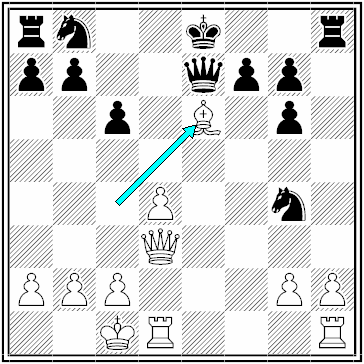
7...a6 (diagram)
This cant be right !!!
8.axb5 cxb5 9.Nxb5 (diagram)
I won my gambit pawn back and my position is far better !!!
But my opponent got me into a known Slav ambush.
9...axb5!!! 10.Rxa8 Bb7 11.Ra1
I started to feel unconfortable, especially since my opponent was smiling all the time
11...Nxe4 (diagram)
And here I knew I was in really deep shit
12.Be2
Desperately trying to get my king into safety
12...Bb4+ (diagram)
Black develops quickly
13.Bd2 Nxd2 14.Nxd2 Qg5 (diagram)
Here I decided to resign. My king has no place to go as castling queenside is not possible anymore.
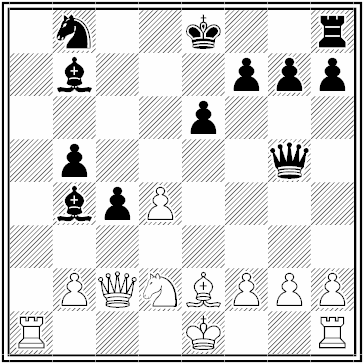
What a nice trap !!
Lessons learned - stick to the Blackmar Diemer and dont mess with Slav gambits.
Tuesday, August 12, 2014
Thursday, August 7, 2014
Fixing the Ziegler
My previous post "A blow to the Ziegler" showed some problems in the "new" Ziegler lines.
After 1.d4 d5 2.e4 dxe4 3.Nc3 Nf6 4.f3 exf3 5.Nxf3 c6 6.Bc4 Bf5 7.Bg5 e6 8.Nh4 Bg6 9.Nxg6 hxg6 10.Qd3 Be7 11.0-0-0 Ng4, black seems to be clearly on top.
Not that this is the only problem to be fixed - after 11.0-0-0, a quick scan with Stockfish unearths many more problematic black moves, but that is another problem...
Back to the lines aftre 11...Ng4. It is obvious that 12.Bxe7 Qxe7 are necessary.
In my previous post, I only considered the aggressive 13.Bxe6, but now I am pretty sure that 13.Qf3 (diagram) is the best move.
It seems to me that both 13...Nf6 and 13...Qh4 are possible for black. Let;s look at 13...Nf6. White now tries to open the centre with 14.d5 (diagram).
It seems to me white has at leats an equal game in all lines, apart from one : 14...Rh4 !!! (diagram) Obviously, this move is hard to find over the board, but it poses white some serious problems.
a/ 15.d6 Qd8 16.Qe2
...a1/ 16...Nbd7 17.Kb1 (=) to (=+)
...a2/ 16...b5 17.Bxe6 fxe6 18.Qxe6+ Kf8 19.g3 (=)
...a3/ 16...Kf8 17.g3 (=)
b/ 15.Bb3
...b1/ 15...cxd5 16.Rhe1 (=+)
...b2/ 15...Nxd5 16.Nxd5 cxd5 17.Rhe1 (=+)
c/ 15.dxe6 Rxc4 16.exf7+ Kxf7 17.Rhe1 Qc7 18.Ne4 Rxe4!! 19.Rxe4 Nbd7 (=+)
d/ 15.dxc6 Nxc6 16.Bb5 Qc7 (=+)
So we see that 13.Qf3 Nf6 14.d5 Rh4 15.d6 Qd8 16.Qe2 gives a hard, but playable game.
What a relief, I beleived for some time the Ziegler actually did refute the Blackmar Diemer ! but that does not seem to be the case - provided I can fix all other problems :-(
After 1.d4 d5 2.e4 dxe4 3.Nc3 Nf6 4.f3 exf3 5.Nxf3 c6 6.Bc4 Bf5 7.Bg5 e6 8.Nh4 Bg6 9.Nxg6 hxg6 10.Qd3 Be7 11.0-0-0 Ng4, black seems to be clearly on top.
Not that this is the only problem to be fixed - after 11.0-0-0, a quick scan with Stockfish unearths many more problematic black moves, but that is another problem...
Back to the lines aftre 11...Ng4. It is obvious that 12.Bxe7 Qxe7 are necessary.
In my previous post, I only considered the aggressive 13.Bxe6, but now I am pretty sure that 13.Qf3 (diagram) is the best move.
It seems to me that both 13...Nf6 and 13...Qh4 are possible for black. Let;s look at 13...Nf6. White now tries to open the centre with 14.d5 (diagram).
It seems to me white has at leats an equal game in all lines, apart from one : 14...Rh4 !!! (diagram) Obviously, this move is hard to find over the board, but it poses white some serious problems.
a/ 15.d6 Qd8 16.Qe2
...a1/ 16...Nbd7 17.Kb1 (=) to (=+)
...a2/ 16...b5 17.Bxe6 fxe6 18.Qxe6+ Kf8 19.g3 (=)
...a3/ 16...Kf8 17.g3 (=)
...b1/ 15...cxd5 16.Rhe1 (=+)
...b2/ 15...Nxd5 16.Nxd5 cxd5 17.Rhe1 (=+)
d/ 15.dxc6 Nxc6 16.Bb5 Qc7 (=+)
So we see that 13.Qf3 Nf6 14.d5 Rh4 15.d6 Qd8 16.Qe2 gives a hard, but playable game.
What a relief, I beleived for some time the Ziegler actually did refute the Blackmar Diemer ! but that does not seem to be the case - provided I can fix all other problems :-(
Thursday, June 26, 2014
A simple trap in the lemberger countergambit
This morning I enjoyed a simple victory in the Lemberger.
1.d4 d5 2.e4 dxe4 3.Nc3 e5 4.Nxe4 exd4 5.Bb5+ c6 6.Qe2 (diagram)
My opponent played the second best move here : 6...Be6 7.Bc4
And now fell for the simple trap 7...Bxc4 8.Bf6#
Surely it was just a blitz game, but I have won the same trap in a normal over the board game against an opponent rated fide 1750, so it is \surely not as simple as it seems. Let's look at the possibility starting from move 6.
a. 6...Be6 7.Bc4 (diagram)
...a1/ 7...Bb4+ 8.Bd2
......a1a/ 8....Bxd2+ 9.Nxd2 (+=)
......a1b/ 8....Bxc4 9.Nf6+ Kf8 10.Bxb4+ Ne7 11.Qxc4 (+)
......a1c/ 8....Qe7 9.0-0-0 Bxd2+ 10.Rxd2 (+)
......a1d/ 8....d3 9.cxd3 (+=)
...a2/ 7...Bd6 8.Bxe6 fxe6 9.Qg4 (+)
...a3/ 7...Be7 8.Bxe6 fxe6 9.Nf3 (+=)
...a4/ 7...Nf6 8.Ng5 (+=)
...a5/ 7...Na6 8.Bxe6 fxe6 9.Nf3 (+=)
b. 6...Be7 7.Bc4 (diagram)
...b1/ 7...Bf5 8.Nf3 (=)
...b2/ 7...Be6 8.Bxe6 fxe6 9.Nf3 (+=)
...b3/ 7...b5 8.Bd3 (+=)
...b4/ 7...Nf6 8.Nxf6+ gxf6 9.Qh5 (+=)
c/ 6...Qe7 7.Nd6+ Kd8 8.Qxe7 Kxe7 9.Nxc8+ Kd7 10.Bc4 (+=)
d/ 6...Bb4+ 7.c3 ( there are better ways for white, but this one is the only ones that maintains some winning chances for white ) (diagram)
1.d4 d5 2.e4 dxe4 3.Nc3 e5 4.Nxe4 exd4 5.Bb5+ c6 6.Qe2 (diagram)
My opponent played the second best move here : 6...Be6 7.Bc4
And now fell for the simple trap 7...Bxc4 8.Bf6#
Surely it was just a blitz game, but I have won the same trap in a normal over the board game against an opponent rated fide 1750, so it is \surely not as simple as it seems. Let's look at the possibility starting from move 6.
a. 6...Be6 7.Bc4 (diagram)
...a1/ 7...Bb4+ 8.Bd2
......a1a/ 8....Bxd2+ 9.Nxd2 (+=)
......a1b/ 8....Bxc4 9.Nf6+ Kf8 10.Bxb4+ Ne7 11.Qxc4 (+)
......a1c/ 8....Qe7 9.0-0-0 Bxd2+ 10.Rxd2 (+)
......a1d/ 8....d3 9.cxd3 (+=)
...a2/ 7...Bd6 8.Bxe6 fxe6 9.Qg4 (+)
...a3/ 7...Be7 8.Bxe6 fxe6 9.Nf3 (+=)
...a4/ 7...Nf6 8.Ng5 (+=)
...a5/ 7...Na6 8.Bxe6 fxe6 9.Nf3 (+=)
b. 6...Be7 7.Bc4 (diagram)
...b1/ 7...Bf5 8.Nf3 (=)
...b2/ 7...Be6 8.Bxe6 fxe6 9.Nf3 (+=)
...b3/ 7...b5 8.Bd3 (+=)
...b4/ 7...Nf6 8.Nxf6+ gxf6 9.Qh5 (+=)
c/ 6...Qe7 7.Nd6+ Kd8 8.Qxe7 Kxe7 9.Nxc8+ Kd7 10.Bc4 (+=)
d/ 6...Bb4+ 7.c3 ( there are better ways for white, but this one is the only ones that maintains some winning chances for white ) (diagram)
...d1/ 7...cxb5 8.cxb4
......d1a/ 8...Ne7 9.Qxb5+ (-)
......d1b/ 8...Nc6 9.Bf4 (=)
......d1c/ 8...a6 9.Bf4 (+=)
......d1d/ 8...Qe7 9.Nd6+ (+=)
......d1e/ 8...Bd7 9.Bg5 (+)
......d1f/ 8...Be6 9.Qxb5+ Nc6 10.Bf4 (=)
...d2/ 7...dxc3 8.bxc3 (=)
...d3/ 7...Be7 8.Bc4 (+=)
...d4/ 7...Ne7 8.Bd3 (=)
...d4/ 7...Qe7 8.cxb4 cxb4 9.Nd6+ (+=)
So we see that the gambit has many traps that may lead so a quick win, but it is not really correct, as it can be refuted, but white is no material down and can still fight back after 6...Bb4+ 7.c3 cxb5 8.cxb4 Ne7 9.Qxb5+ Nbc6 10.Ne2 (diagram)
Tuesday, June 24, 2014
A blow to the Ziegler
The Ziegler defense ( 1.d4 d5 2.e4 dxe4 3.Nc3 Nf6 4.f3 exf3 5.Nxf3 c6 6.Bc4 Bf5 has always posed a problem to the attacker as the traditional lines 7.0-0 e6 8.Ne5 is insufficient.
However, 7.Bg5 e6 8.Nh4 Bg6 9.Nxg6 hxg6 10.Qd3 (diagram) gives white decent chances.
Blitz play this morning continued 10...Be7 11.0-0-0 and now the new move 11...Ng4 (diagram)
Black wants to exchange some pieces and eyes the f2 square for his jumper - what can you expect more from a move ?
Play went 12.Bxe7 Qxe7 and now I threw in the standard sacrifice 12.Bxe6 (diagram)
Obvioulsy, I was hoping for 13...fxe6 14.Qxg6+ (++), but that would have been too easy.
My blitz opponent played 13...Qg5+ 14.Kb1 fxe6 and now 15.Qg3 (diagram)
Here I thought that white had the advantage, as I have two interesting attacking options
- the knight is pinned and can ve attacjed by means of the simple h3
- my knight can attack the queen with Ne4 and the check on d6.
But it seems that it is actually black who is on top. My trusted silicon assistant gives 15...Qh4 16.Qc7 0-0 17.Qxb7 Nf2 18.Qxa8 Nxh1 19.Qxa7, with black having the piece for two pawns.
Have we discovered the real refutation of white's alternative line in the Ziegler( or O'Kelly ) defense ? It surely looks so....
However, 7.Bg5 e6 8.Nh4 Bg6 9.Nxg6 hxg6 10.Qd3 (diagram) gives white decent chances.
Blitz play this morning continued 10...Be7 11.0-0-0 and now the new move 11...Ng4 (diagram)
Black wants to exchange some pieces and eyes the f2 square for his jumper - what can you expect more from a move ?
Play went 12.Bxe7 Qxe7 and now I threw in the standard sacrifice 12.Bxe6 (diagram)
Obvioulsy, I was hoping for 13...fxe6 14.Qxg6+ (++), but that would have been too easy.
My blitz opponent played 13...Qg5+ 14.Kb1 fxe6 and now 15.Qg3 (diagram)
Here I thought that white had the advantage, as I have two interesting attacking options
- the knight is pinned and can ve attacjed by means of the simple h3
- my knight can attack the queen with Ne4 and the check on d6.
But it seems that it is actually black who is on top. My trusted silicon assistant gives 15...Qh4 16.Qc7 0-0 17.Qxb7 Nf2 18.Qxa8 Nxh1 19.Qxa7, with black having the piece for two pawns.
Have we discovered the real refutation of white's alternative line in the Ziegler( or O'Kelly ) defense ? It surely looks so....
Monday, May 19, 2014
Black loosing time in the Ziegler opening
The Blackmar Diemer defender has no time to loose in the opening. But sometimes, they do think they have all the time for fancy things - that's waht happened to my opponent today in a chess.com blitz game
1.d4 d5 2.e4 dxe4 3.Nc3 Nf6 4.f3 exf3 5.Nxf3 c6 6.Bc4
The Ziegler, which can turn into the O'Kelly defense when combined with a subsequent Bf5.
6...Nd5 (diagram)
Black wants to get rid of that annoying c3 knight, but is there time ?
7.Ne5 !! e6 8.0-0 (diagram)
Dark clouds appear on the horizon - black is forced to retreat his jumper.
8...Nf6 9.Ne4 (diagram)
Being so much behing in development, taking the knight is no option for black, eg 9...Nxe4 10.Nxf7 Qc7 12.Nxh8 (++)
9...Be7 10.Ng5 (diagram)
Black has to defend f7 and can do so in two ways.
a/ 10...0-0 11.Qd3 h6 12.Nexf6 Rxf7 13.Nxe6 Bxe6 14.Bxe6 Qf8 15.Qg6 (+)
b/ 10...Rf8 11.Be3 (+=)
I was actually quite proud of that finding this in a blitz game.
A fair punishment for black loosing so much time in the opening !
1.d4 d5 2.e4 dxe4 3.Nc3 Nf6 4.f3 exf3 5.Nxf3 c6 6.Bc4
The Ziegler, which can turn into the O'Kelly defense when combined with a subsequent Bf5.
6...Nd5 (diagram)
Black wants to get rid of that annoying c3 knight, but is there time ?
7.Ne5 !! e6 8.0-0 (diagram)
Dark clouds appear on the horizon - black is forced to retreat his jumper.
8...Nf6 9.Ne4 (diagram)
Being so much behing in development, taking the knight is no option for black, eg 9...Nxe4 10.Nxf7 Qc7 12.Nxh8 (++)
9...Be7 10.Ng5 (diagram)
Black has to defend f7 and can do so in two ways.
a/ 10...0-0 11.Qd3 h6 12.Nexf6 Rxf7 13.Nxe6 Bxe6 14.Bxe6 Qf8 15.Qg6 (+)
b/ 10...Rf8 11.Be3 (+=)
I was actually quite proud of that finding this in a blitz game.
A fair punishment for black loosing so much time in the opening !
Wednesday, May 14, 2014
Sometimes the attacker has to defend first
I already covered an interesting line in the Paleface in earlier articles : 1.d4 Nf6 2.f3 g6 3.e4 d6 4.Be3 Bg7 5.Qd2 0-0 6.Nc3 c6 7.0-0-0 b5 8.g4 b4. In these articles, I showed that 9.Nce2 is not to be feared as 9...Qa5 can be countered by the simple, yet effective 10.Kb1
Yesterday my blitz opponent played differently and comtinued 1.d4 Nf6 2.f3 g6 3.e4 d6 4.Be3 Bg7 5.Qd2 0-0 6.Nc3 c6 7.0-0-0 b5 8.g4 Qa4 (diagram).
In good Blackmar-Diemer style, I attacked on the opposite end with 9.h4, but came in a difficult position after 9...b4 10.Nce2 Qxa2 11.Qxb4. Black now tried to open up things further with 11...c5 and I found myself quickly in a mating net.
So it is obvious that 9.h4 is far to slow - black's threats have to be dealt with first - I realize this is hard to accept for a Blackmar Diemer gambiteer :-(
After analysis it seems there are multiple white candidates : 9.a3, 9.Kb1, 9.g5, maybe even 9.b3 ( which I dont like as it opens the whole diagonal for the black bishop ).
9.g5 (diagram) seems insufficient as the black knigt can safely jump to h5, halting white's attack. White now has to play a3 or Kb1 anyway, so this seems like a loss of time.
White can transpose into the lines described earlier by 9.Kb1 b4 10.Nce2 with an equal game.
9.a3 b4 10.Na2 (diagram) seems the best option for white
10...c5 seems the most dangerous continuation here, but white has nothing to fear after 11.Kb1.
10...Na6 is met by the simple 11.Bxa6 and white is on top.
So there is nothing to fear in the Paleface - provided the gambiteer defends from time to time...
Yesterday my blitz opponent played differently and comtinued 1.d4 Nf6 2.f3 g6 3.e4 d6 4.Be3 Bg7 5.Qd2 0-0 6.Nc3 c6 7.0-0-0 b5 8.g4 Qa4 (diagram).
In good Blackmar-Diemer style, I attacked on the opposite end with 9.h4, but came in a difficult position after 9...b4 10.Nce2 Qxa2 11.Qxb4. Black now tried to open up things further with 11...c5 and I found myself quickly in a mating net.
So it is obvious that 9.h4 is far to slow - black's threats have to be dealt with first - I realize this is hard to accept for a Blackmar Diemer gambiteer :-(
After analysis it seems there are multiple white candidates : 9.a3, 9.Kb1, 9.g5, maybe even 9.b3 ( which I dont like as it opens the whole diagonal for the black bishop ).
9.g5 (diagram) seems insufficient as the black knigt can safely jump to h5, halting white's attack. White now has to play a3 or Kb1 anyway, so this seems like a loss of time.
White can transpose into the lines described earlier by 9.Kb1 b4 10.Nce2 with an equal game.
9.a3 b4 10.Na2 (diagram) seems the best option for white
10...c5 seems the most dangerous continuation here, but white has nothing to fear after 11.Kb1.
10...Na6 is met by the simple 11.Bxa6 and white is on top.
So there is nothing to fear in the Paleface - provided the gambiteer defends from time to time...
Monday, May 12, 2014
Yes, Boris, there is a Blackmar-Diemer gambit.
Yes, chess players from all over the world, yes indeed, there is a Blackmar-Diemer gambit.
Please read this magnificent article by Tom Purser, written in 1989 based on an editorial in the "New York Sun" from 1897.
Thank you Tom, for all the joy you brought to us with your BDG World magazine.
Please read this magnificent article by Tom Purser, written in 1989 based on an editorial in the "New York Sun" from 1897.
Thank you Tom, for all the joy you brought to us with your BDG World magazine.
Subscribe to:
Posts (Atom)