Canada is leading the all-time pageviews on my blog, far ahead of the United States, followed by Belgium and the United Kingdom and France.
The first visitor ever on my blog, way back in March 2011 ( apart from myself and my wife ) came from Iran.
The most popular browser is Safari ( on Mac ), whilst Windows clients are still leading over Mac and iPad.
Thanks to you all for visiting my site !
Sunday, April 28, 2013

Saturday, April 27, 2013
The Latvian-Blackmar-Diemer gambit
I focused on the Sneiders Attack some time ago, and concluded black has the upper hand. But what should white play when black bravely counterattacks with 1.d4 d5 2.e4 dxe4 3.Nc3 e5 ? My favorite has always been 4.Nxe4, as white maintains a complicated game.
Balck can respond in several ways, today I will focus on black's best move 4...Qxd4 after which white must play 5.Bd3.
Black now has the luxury of choice, the strongest being 5...f5 6.Nf3 (diagram)

Where should the black majesty go ? Let's see what happens when she moves back to her original place, home sweet home, after all ?
White now has 7.Neg5 (diagram)

Black might now be tempted into 7...e4, trying to win a piece. But now comes the move 8.Ne5!! (diagram)

Wow, what a move ! But my silicon assistant does find some great lines that no human will ever find behind the board ( unless of course you read my column ). Now we cant examine all possible moves here, but let's see whta happens if black eats the piece - a piece is a piece after all !!
8...exd3 9.00 (diagram)

a/ 9...Qf6 10.Rfe1
My computer sees this now as a line from the Latvian gambit (C40) !!! Maybe he just wants to be kind to me, as he knows I love the Latvian nearly as much as the Blackmar-Diemer
......a1b/ 11...h6 12.Nxh8 g6 13.Ngf7 (+=)
......a1c/ 11...g6 12.Qxd3 (++)
......a1d/ 11...Rg7 12.Qxd3 (++)
b/ 9...Qd5 10.Re1 Be7 11.Qh5+ (+)
Balck can respond in several ways, today I will focus on black's best move 4...Qxd4 after which white must play 5.Bd3.
Black now has the luxury of choice, the strongest being 5...f5 6.Nf3 (diagram)

Where should the black majesty go ? Let's see what happens when she moves back to her original place, home sweet home, after all ?
White now has 7.Neg5 (diagram)
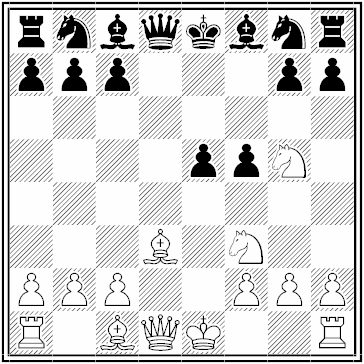
Black might now be tempted into 7...e4, trying to win a piece. But now comes the move 8.Ne5!! (diagram)

Wow, what a move ! But my silicon assistant does find some great lines that no human will ever find behind the board ( unless of course you read my column ). Now we cant examine all possible moves here, but let's see whta happens if black eats the piece - a piece is a piece after all !!
8...exd3 9.00 (diagram)

a/ 9...Qf6 10.Rfe1
My computer sees this now as a line from the Latvian gambit (C40) !!! Maybe he just wants to be kind to me, as he knows I love the Latvian nearly as much as the Blackmar-Diemer
...a1/ 10...Ne7 11.Nef7
......a1a/ 11...f4 12.Bxf4 (offering a second piece) Qxf3 13.Qxd3 (+=)......a1b/ 11...h6 12.Nxh8 g6 13.Ngf7 (+=)
......a1c/ 11...g6 12.Qxd3 (++)
......a1d/ 11...Rg7 12.Qxd3 (++)
......a1e/ 11...Nc6 12.Nxh8 (+=)
......a1f/ 11...Nd7 12.Nxh8 (++)
...a2/ 10...Be7 11.Nef7
......a2a/ 11...h6 12.Nxh8 hxg5 13.Qh5+ Kd7 14.Qh7 (+)
......a2b/ 11...f4 12.Qxd3 (+=)
......a2c/ 11...Nc6 12.Nxh8 (+=)
b/ 9...Qd5 10.Re1 Be7 11.Qh5+ (+)
c/ 9...Qd4 10.Nef7 (+=)
d/ 9...Nf6 10.Nef7 (+)
e/ 9...Nc6 10.Qh5+ g6 11.Nxg6 Nf6 12.Re1+ (+=)
So we have it finally confirmed - the Blackmar-Diemer is superior to the Latvian !
Friday, April 19, 2013
Minor line in the Euwe
Sometimes people hate it when their opponent doesn't play the recommended book moves. So do I. It is so frustrating to see your opponent deviate from the main line - you know the line he plays is not the best, but how to refute it ? That sometimes gets to you, and you fail to play good moves.
So a good preparation is crucial, especially when playing sharp opening.
That's why I consider today one of these inferior, but very hard to beat sidelines in the Euwe defense.
1.d4 d5 2.e4 dxe4 3.Nc3 Nf6 4.f3 exf3 5.Nxf3 e6 6.Bg5 Nc6 (diagram)
My silicon assistant kindly suggests 4 options :
a/ 7.Bb5 (diagram)
 ...a1/ 7...Be7 8.00 (=)
...a2/ 7...Bd7 8.d5 exd5 9.Nxd5 (=)
...a3/ 7...a6 8.Bxc6+ bxc6 9.Ne5 (=)
...a4/ 7...Bd6 8.00 (=)
b/ 7.Ne4 (diagram)
 After 7...Be7, white has nothing else than 8.Nxf6+ (=)
c/ 7.Bd3 (diagram)
 After 7...Be7 we reach a well known position which is hard to play for many gambiteers.
d/ 7.Qd2 (diagram)
 7...h6 urges white to exchange or retreat, but weakens his kingside. This might not be bad, since black can force the exchange, eg 7...h6 8.Bf4 Bd6 (=+)
So I believe the simple 8.Bb5 is strongest. Black can force a small advantage after 7...Be7. But I will cover that in a later blog.
So we see these so called bad moves are not that bad at all !
So a good preparation is crucial, especially when playing sharp opening.
That's why I consider today one of these inferior, but very hard to beat sidelines in the Euwe defense.
1.d4 d5 2.e4 dxe4 3.Nc3 Nf6 4.f3 exf3 5.Nxf3 e6 6.Bg5 Nc6 (diagram)
My silicon assistant kindly suggests 4 options :
a/ 7.Bb5 (diagram)

...a2/ 7...Bd7 8.d5 exd5 9.Nxd5 (=)
...a3/ 7...a6 8.Bxc6+ bxc6 9.Ne5 (=)
...a4/ 7...Bd6 8.00 (=)
b/ 7.Ne4 (diagram)

c/ 7.Bd3 (diagram)

d/ 7.Qd2 (diagram)

So I believe the simple 8.Bb5 is strongest. Black can force a small advantage after 7...Be7. But I will cover that in a later blog.
So we see these so called bad moves are not that bad at all !
Tuesday, April 16, 2013
Chess and abstract art
I am back from a week of holiday in a sunny place, but still found the time to visit an exposition with my two children on the paintings of Wassily Kandinsky ( http://www.expo-kandinsky.be/ ), the father of the abstract art.
Kandinsky was born in Moscow in 1866 and died in France in 1944. He is widely considered the first abstract painter. I really recommend anybody to see his work when you get the chance - Abstract paintings might seem rather strange to you at first sight, but it really starts making sense when you try to understand the underlying ideas.

Now I wont go as far as saying that chess is art, but if the games of Anderssen relate to the "romantic" form of art, and Steinitz ( with his positiona play ) and Alekhine ( with his treatment of the opening ) are exponents of the more "realistic" or "modern" treatment, Kandinsky might represent the attacking and chaotic form of chess that is associated with the Blackmar Diemer gambit.
One of the basic ideas of abstract art is "The form is the material expression of the abstract contents". Guess this applies to our beloved gambit - the sacrifice of the f pawn ( the form ) is the expression of the abstract contents ( the immediate attack on the enemy king and the desire to risk all to mate the enemy king ).
Some might argue that the resulting positions in the Blackmar Diemer look like an abstract painting, but I can assure you - that is purely coincidence... :-)
Kandinsky was born in Moscow in 1866 and died in France in 1944. He is widely considered the first abstract painter. I really recommend anybody to see his work when you get the chance - Abstract paintings might seem rather strange to you at first sight, but it really starts making sense when you try to understand the underlying ideas.

Now I wont go as far as saying that chess is art, but if the games of Anderssen relate to the "romantic" form of art, and Steinitz ( with his positiona play ) and Alekhine ( with his treatment of the opening ) are exponents of the more "realistic" or "modern" treatment, Kandinsky might represent the attacking and chaotic form of chess that is associated with the Blackmar Diemer gambit.
One of the basic ideas of abstract art is "The form is the material expression of the abstract contents". Guess this applies to our beloved gambit - the sacrifice of the f pawn ( the form ) is the expression of the abstract contents ( the immediate attack on the enemy king and the desire to risk all to mate the enemy king ).
Some might argue that the resulting positions in the Blackmar Diemer look like an abstract painting, but I can assure you - that is purely coincidence... :-)
Sunday, March 31, 2013
An alternative, but incorrect move order
Playing with the black pieces, my friend faced an unusual Blackmar Diemer opening last friday in our teammatch. The move order was as follows : 1.d4 Nf6 2.f3 d5 and now the surprising 3.Nc3!! (diagram)

Play continued 3...Bf5 and a Vienna game appeared after 4.e4 dxe4 5.fxe4 Nxe4 6.Qf3.
Personally, I have never seen this move order, with 3.Nc3 preceding 3.e4 in the Paleface. But can black take advantage of this rather strange move order ? Immediately after the game, I suggested 3...c5 (diagram) and my silicon friend agrees.

The f3 pawn now looks rather silly, unless of course white pulls off 4.e4 anyway. But this seems to give black the advantage after 4.e4 cxd4 5.Qxd4 Nc6 6.Bb5 Bd7 and black is doing great.
So the suggested move order 1.d4 Nf6 2.f3 d5 3.Nc3 is refuted by an immediate c5 as the white f3 pawn is useless.

Play continued 3...Bf5 and a Vienna game appeared after 4.e4 dxe4 5.fxe4 Nxe4 6.Qf3.
Personally, I have never seen this move order, with 3.Nc3 preceding 3.e4 in the Paleface. But can black take advantage of this rather strange move order ? Immediately after the game, I suggested 3...c5 (diagram) and my silicon friend agrees.

The f3 pawn now looks rather silly, unless of course white pulls off 4.e4 anyway. But this seems to give black the advantage after 4.e4 cxd4 5.Qxd4 Nc6 6.Bb5 Bd7 and black is doing great.
So the suggested move order 1.d4 Nf6 2.f3 d5 3.Nc3 is refuted by an immediate c5 as the white f3 pawn is useless.
Monday, March 18, 2013
The Sneiders Attack - refuted.
Black does not have to be cooperative when defending against the Blackmar Diemer gambit - a timely e5 can destroy white's ambitions 1.d4 d5 2.e4 dxe4 3.Nc3 e5! White has three options now : 4.Nxe4, 4.Nge2 and 4.Qh5 (diagram). We will analyse the Schneiders Attack today.

Can black take a second pawn an survive ?? If so, we should not consider the Schneider Attack anymore since it is well known that 4...Nc6 is also quite strong,
Let's look at 4...exd4 ( realising that black can take the pawn with the queen also, maybe even stronger than the text move ). I guess the only serious white option is 5.Bc4 (diagram), since both 5.Nxe4 and 5.Qe5 are countered by 5...Qe7.

Play continues 6.Bg5 Nf6 7.Bxf6 Qxf6 8.Nxe4 Qe7.
Black might have other options here, such as 8...Bb4+ 9.c3 Qf5 resulting in equal play.
And now the killer move 9.000 (diagram)

Black is a pawn ahead, so he doesnt have to take the piece that is offered to him, eg 9...g6 10.Qe2 Bh6+ 11.Kb1 Nc6 with equality.
But what happens if black does take the baite ? 9...Qxe4 10.Qxf7+ Kd8 11.Nf3.
Scheerer suggests 11...c5 only, indicating that 11...Bd6 was suggested by Kaissiber.
11...Bd6 12.Qxg7 and now a nice improvement 12....Rf8 (diagram)

Kaissiber suggested only 12...Re8, but the text move is better.
a/ 13.Ng5 Qf4+ 14.Kb1 Qf6 15.Nf7+ Rxf7 16.Qxf7 Qxf7 17.Bxf7 c5 (=)
b/ 13.Nxd4 Qe7 (=+)
c/ 13.Rxd4 Qe7 (=+)
d/ 13.Rhe1 Qf4+ 14.Kb1 Qf6 (=+)
e/ 13.Qxf8+ Bxf8 14.Rxd4+ Qxd4 15.Nxd4 (=+)
See we see that there is no advantage for the attacker in the Sneiders Attack.

Can black take a second pawn an survive ?? If so, we should not consider the Schneider Attack anymore since it is well known that 4...Nc6 is also quite strong,
Let's look at 4...exd4 ( realising that black can take the pawn with the queen also, maybe even stronger than the text move ). I guess the only serious white option is 5.Bc4 (diagram), since both 5.Nxe4 and 5.Qe5 are countered by 5...Qe7.

Play continues 6.Bg5 Nf6 7.Bxf6 Qxf6 8.Nxe4 Qe7.
Black might have other options here, such as 8...Bb4+ 9.c3 Qf5 resulting in equal play.
And now the killer move 9.000 (diagram)

Black is a pawn ahead, so he doesnt have to take the piece that is offered to him, eg 9...g6 10.Qe2 Bh6+ 11.Kb1 Nc6 with equality.
But what happens if black does take the baite ? 9...Qxe4 10.Qxf7+ Kd8 11.Nf3.
Scheerer suggests 11...c5 only, indicating that 11...Bd6 was suggested by Kaissiber.
11...Bd6 12.Qxg7 and now a nice improvement 12....Rf8 (diagram)

Kaissiber suggested only 12...Re8, but the text move is better.
a/ 13.Ng5 Qf4+ 14.Kb1 Qf6 15.Nf7+ Rxf7 16.Qxf7 Qxf7 17.Bxf7 c5 (=)
b/ 13.Nxd4 Qe7 (=+)
c/ 13.Rxd4 Qe7 (=+)
d/ 13.Rhe1 Qf4+ 14.Kb1 Qf6 (=+)
e/ 13.Qxf8+ Bxf8 14.Rxd4+ Qxd4 15.Nxd4 (=+)
See we see that there is no advantage for the attacker in the Sneiders Attack.
Thursday, March 7, 2013
A man with a mission
In column "A subtle difference" we looked at the subtle difference between the Teichmann and Gunderam lines. A small difference indeed, but with important consequences. We learned that, in the Gunderam, white should refrain from the normal "Teichmann" continuation 12.00 and choose 12.Rf1 (diagram) instead in the position occuring after 1.d4 d5 2.e4 dxe4 3.Nc3 Nf6 4.f3 exf3 5.Nxf3 Bf5 6.Ne5 e6 7.g4 Bg6 8.Qf3 c6 9.g5 Nd5 10.Bd3 Qc7 11.Bxg6 hxg6.


It seems to me that black's only reply is 12...Bb4 13.Bd2 00 14.Nxd5 Bxd2 15.Kxd2 cxd5 16.Nxg6 (diagram)

All of these moves seem to be forced for black, so let's look at the above position :
a/ 16...Nc6 17.Nxf8 Nxd4 18.Qd3
...a1/ 18...Qxh2+ 19.Kd1 (=)
...a2/ 18...Nf5 19.Nxe6 (+=)
b/ 16...Rc8 17.Ne5
...b1/ 17...Qxc2+ 18.Ke3 Qf5 19.Qxf5 exf5 20.Rxf5 (=)
...b2/ 17...Nc6 18.Qxf7+ Qxf7 19.Nxf7 Nxd4 20.c3 (=)
c/ 16...Re8 17.Ne5 Nc6 18.Qxf7+ Qxf7 19.Nxf7
...c1/ 19...Re7 20.g6 Nxd5 21.Rae1 (+=)
...c2/ 19...Rf8 20.g6 Nxd5 21.Rae1 (+=)
...c3/ 19...Nxd5 20.Rae1 (+=)
Seems like interesting positions for players with a mission !
a/ 16...Nc6 17.Nxf8 Nxd4 18.Qd3
...a1/ 18...Qxh2+ 19.Kd1 (=)
...a2/ 18...Nf5 19.Nxe6 (+=)
b/ 16...Rc8 17.Ne5
...b1/ 17...Qxc2+ 18.Ke3 Qf5 19.Qxf5 exf5 20.Rxf5 (=)
...b2/ 17...Nc6 18.Qxf7+ Qxf7 19.Nxf7 Nxd4 20.c3 (=)
...c1/ 19...Re7 20.g6 Nxd5 21.Rae1 (+=)
...c2/ 19...Rf8 20.g6 Nxd5 21.Rae1 (+=)
...c3/ 19...Nxd5 20.Rae1 (+=)
Seems like interesting positions for players with a mission !
Subscribe to:
Posts (Atom)