Tuesday, October 21, 2014

Did he finally go mad ?

This afternoon, I got to talk to one of my BDG buddies. We went through my sunday game which I started off as follows :

1.d4 Nf6 2.f3
Inviting ( no, begging !! )  my opponent to go into a Blackmar Diemer... But alas, my opponent wisely thanked for the invitation.
2...g6
I played the normal (??) move here.
3.e4

"Stop right here", my chess buddy said. "Why not consider 3.g4 ?? You will play it lateron anyway - why not play it right now ?"

At first, I could not believe my eyes. But my friend was right - what is keeping me from this adacious move ? It is a legal move after all !

Let's check out the natural line 3...Bg7 4.h4 (diagram)

Now believe me or not, my Stockfish chess assistant indicates that only one move offers black an advantage. Can you find it ? I bet you wont.

Let's check out a few alternatives

a/ 4...d6 ( the normal Pirc-ish move ) 5.h5

and now black only has 5...gxh5 6.g5 Nfd7 7.Rh5 leading to equality.

b/ 4...c5 5.d5
\
...b1/ 5...e6 6.e4 exd5 7.e5 (?!)
......b1a/ 7...Qe7 8.Qe2 Ng8 9.Nc3 (=)
......b1b/ 7...Ng8 8.Nc3 d4 9.Nd5 Ne7 10.Nf6+ (=+) with a complicated game
...b2/ 5...d6 6.e4 (=)
...b3/ 5...Qa5+ 6.Kf2 !!!! (=)
...b4/ 5...0-0 6.h5 (=)

c/ 4...d5 5.h5

...c1/ 5...Qd6 6.Nh3 (=)
...c2/ 5...c5 6.h6 Bf8 7.e3 (=)
...c3/ 5...gxh5 6.g5
......c3a/ 6...Nfd7 7.Nh3 (=)
......c3b/ 6...Ng8 7.Nh3 (=)

I am sure you will tell me this opening does not make sense. But hey, remember Diemer's "immortal" game against Trommsdorf in 1975 in Bagnieux, France. That game stood the test of time - and I am sure, most of our games wont be remembered in 50 years time...

Monday, October 13, 2014

Cleaning up old stuff

Today I was sort of forced by my wife to clean up my study room. Unlike the room of my daughters, my study room is filled with chess related stuff - you will find no posters of the latest boys band, merely a few CD's of Bob Dylan or Neil Young. And chess stuff. That's it, but it's enough to drive my wife crazy. In any case, whilst realigning my stuff a bit, thus satisfying the master of the family, I came upon a nice game I played last year.

Guido De Bouver - Tony Peleman
Mechelen, 2013.
1.d4 d5 2.e4 dxe4 3.Nc3 Nf6 4.f3 exf3 5.Nxf3 Bg4 6.h3 Bh5 7.g4 Bg6 8.Ne5 Nfd7 ?!

I had never seen this move before. Challenging my outpost knight with 8...Nbd7 is often seen, after which white gets a decent attack with the thematic 9.Qf3. But this move seems to violate the basic rules of the chess openings, as the knight is moved twice.

I decided to continue with 9.Qf3 c6 10.Nxg6 hxg6 11.Bc4 e6 12.0-0 and the came equalized somehow.

During analysis, it became obvious I had let the fish off the hook at move 11. And indeed, the odd looking 11.Rh2 !? seems the simplest way for white to complicate things and keeping the pressure on the defender. It might not be the sttrongest move, but certainly is the most difficult for black to defend against.

So let's chekc out 11.Rh2

It seems there are only a few decent black replies : 11...e5 and 11...e6.

a/ 11...e5 12.Rf2 (diagram)
...a1/ 12...f6 13.Bd3 (+)
...a2/ 12...Qe7 13.Bf4 !! (+)
...a3/ 12...Qf6 13.Qd3
......a3a/ 13...Qh4 14.Be3 (+=)
......a3b/ 13...Qe7 14.Bf4 (+=)
......a3c/ 13...Qe6 14.d5 (+=)
......a3d/ 13...Qd6 14.Be3 (+=)
......a3e/ 13...Qd8 14.Be3 (+=)

b/ 11...e6 12.Rf2 (diagram)
...b1/ 12...Qf6 13. Qe3
......b1a/ 13...Qe7 14. Bd2 (+=)
......b1b/ 13...Qd8 14.Bd2 (+=)
......b1c/ 13...Qh4 14.Qf4 Qe7 15.Be3 (+=)
...b2/ 12...Qe7 13.Bf4 (+)


Editor's note : it seems Guido forgot about his post "Handling the do nothing line" where the line 1.d4 d5 2.e4 dxe4 3.Nc3 Nf6 4.f3 exf3 5.Nxf3 Bg4 6.h3 Bh5 7.g4 Bg6 8.Ne5 Nfd7 9.Nxg6 hxg6 10.Bg5.
Guess it is a matter of taste which line is better :-)

Sunday, September 21, 2014

The sacrifice on e4 in the Paleface Pirc

Yesterday I was crushed to death in a Paleface Pirc. The game was played at fast speed, but still, I was sort of humiliated with my opening. read carefully so you dont end up like this !

Guido De Bouver - Roel Hamblok ( Antwerpen )
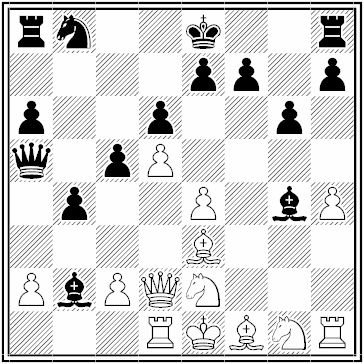
1.d4 c5 2.d5 g6 3.e4 Bg7 4.Nc3 d6 5.Be3 Nf6 6.Qd2 Qa5 7.f3 a6 8.g4 b5 (diagram)

White has declared his intentions on the kingside whilst blacks expands on the queenside - a typical idea in the Paleface Pirc.

My next move was too slow : 9.h4. This move is too slow as it allows for 9...h5, but my opponent had a different plan : 9...b4 (diagram)

Oh horror - black is attacking a piece first. Probably an indication that I am not doing so well. But now I missed a simple sacrifice.

10.Nce2 ??? (diagram)

As soon as I released my piece, I saw the combination. 10.Nd1 would have been ok for white.

10...Nxe4 Of course.
11.fxe4 Bxb2 12.Rad1 Bxg4 (diagram)


And with one piece for three pawns, I could safely resign here as my position is hopeless.

Dont fall for this idea - it can happen in other Paleface Pirc positions also.


Friday, September 5, 2014

The times they are a changing.

Yes, the times they are a-changing. And so does the evaluation of some wild Blackmar Diemer lines.

Take the obscure line in teh Ziegler ( aka O'kelly ) defense 1.d4 d5 2.e4 dxe4 3.Nc3 Nf6 4.f3 exf3 5.Nxf3 c6 6.Bc4 Bf5 7.g4  !! This line was suggested by IM Stefan Bucker in a famous article published in 2010 on chesscafe.com.

I have played trhis lately twice in five minute games on chess.com and both of my opponents went astray quickly. And also, the gambit has some real potency. Look at the line

7...Nxg4 8.Nh4 g6 9.Nxf5 gxf5 10.h3 Nf6 11.Bg5 e6 and now 12.d5 (diagram)

I challenge you to defend this position here as black. Not simple, is it ?

I wont go as far as saying that 7.g4 is better than 7.Bg5. I wont play it, certainly not in rated over-the-board games, but it is perfect for blitz games.

And who knows, maybe one day, the times will be changing...


Monday, September 1, 2014

Bypassing that annoying Vienna defense

I have always hated the Vienna defense since black is always able to exchange some pieces and thus reduce white's winning chances. I always felt that white is fighting for a draw.

For that reason, I have worked in the past on several white options, originating aftre 5.g4 Bg6 6.g5 Nd5 7.Nxe4. Not without any modesty on my part, the line 7...Nc6 8.c4 was dubbed the "De Bouver attack" and yielded terrible complications.

However, black could bypass this dreaded attack and simply play 7...e6 and now 8.h4 does not seem to equalize.

That's why I look today at the next white option : the "More than Hara Kiri" line, originating after 1.d4 d5 2.e4 dxe4 3.Nc3 Nf6 4.f3 Bf5 5.g4 Bg6 6.h4 (diagram)

White's most ambituous try is probably 6...Qd6, but white's reply 7.Bg2 is both unexpected and good.

Also interesting is 6...exf3 7.Qxf3 and white gets an equal game with all pieces still on the board.

The popular 6...h5 is rather simple to play for white after 7.g5 Nd5 8.Nxe4 (diagram) and white is certainly not worse than in the lines without the h4 moves.

Let's look now at the best black repsonse, 6...h6. Scheerer suggests 7.Bg2 here, but I think he overlooked the simple 7...Nc6, leaving white a pawn down without any compensation.

Summary : the More than Hara Kiri line seems to be refuted by the simple 6...h6 as Scheerer's suggestion 7. Bg2 does not provide any equality.

Tuesday, August 12, 2014

screwed up in a Slav ambush

I partipated in a tournament last weekend. My 5th round opponent knew I played the Blackmar Diemer and was prepared for it, since I had played a Blackmar Diemer against him a year ago or so.

So I had the bad idea of playimng something else...

1.d4 d5 2.c4
No mother what the grandmasters say : bad choice - 2.e4 is far better/

2...c6
The Slav

3.Nf3 Nf6 4.Nc3 dxc4 5.e4 b5 6.Qc2
My knowledge of theory had ended here. Better was 6.e5, entering the Geller gambit.

6...e6 7.a4
Cant be bad, can it ?

7...a6 (diagram)
This cant be right !!!


8.axb5 cxb5 9.Nxb5 (diagram)
I won my gambit pawn back and my position is far better !!!

But my opponent got me into a known Slav ambush.

9...axb5!!! 10.Rxa8 Bb7 11.Ra1
I started to feel unconfortable, especially since my opponent was smiling all the time

11...Nxe4 (diagram)
And here I knew I was in really deep shit

12.Be2
Desperately trying to get my king into safety

12...Bb4+ (diagram)
Black develops quickly

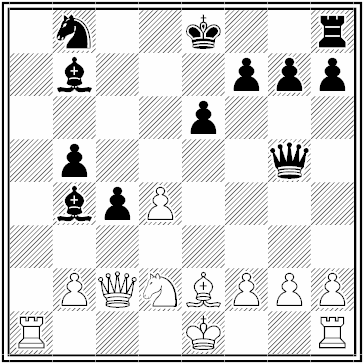
13.Bd2 Nxd2 14.Nxd2 Qg5 (diagram)
Here I decided to resign. My king has no place to go as castling queenside is not possible anymore.

What a nice trap !!

Lessons learned - stick to the Blackmar Diemer and dont mess with Slav gambits.

Thursday, August 7, 2014

Fixing the Ziegler

My previous post "A blow to the Ziegler" showed some problems in the "new" Ziegler lines.

After 1.d4 d5 2.e4 dxe4 3.Nc3 Nf6 4.f3 exf3 5.Nxf3 c6 6.Bc4 Bf5 7.Bg5 e6 8.Nh4 Bg6 9.Nxg6 hxg6 10.Qd3 Be7 11.0-0-0 Ng4, black seems to be clearly on top.

Not that this is the only problem to be fixed - after 11.0-0-0, a quick scan with Stockfish unearths many more problematic black moves, but that is another problem...

Back to the lines aftre 11...Ng4. It is obvious that 12.Bxe7 Qxe7 are necessary.

In my previous post, I only considered the aggressive 13.Bxe6, but now I am pretty sure that 13.Qf3 (diagram) is the best move.


It seems to me that both 13...Nf6 and 13...Qh4 are possible for black. Let;s look at 13...Nf6. White now tries to open the centre with 14.d5 (diagram).


It seems to me white has at leats an equal game in all lines, apart from one : 14...Rh4 !!! (diagram) Obviously, this move is hard to find over the board, but it poses white some serious problems.


a/ 15.d6 Qd8 16.Qe2
...a1/ 16...Nbd7 17.Kb1 (=) to (=+)
...a2/ 16...b5 17.Bxe6 fxe6 18.Qxe6+ Kf8 19.g3 (=)
...a3/ 16...Kf8 17.g3 (=)

b/ 15.Bb3
...b1/ 15...cxd5 16.Rhe1 (=+)
...b2/ 15...Nxd5 16.Nxd5 cxd5 17.Rhe1 (=+)

c/ 15.dxe6 Rxc4 16.exf7+ Kxf7 17.Rhe1 Qc7 18.Ne4 Rxe4!! 19.Rxe4 Nbd7 (=+)

d/ 15.dxc6 Nxc6 16.Bb5 Qc7 (=+)

So we see that 13.Qf3 Nf6 14.d5 Rh4 15.d6 Qd8 16.Qe2 gives a hard, but playable game.

What a relief, I beleived for some time the Ziegler actually did refute the Blackmar Diemer ! but that does not seem to be the case - provided I can fix all other problems :-(