In my quest to refute the refutation of the Teichmann defense, I studied the line 9.Bg2 c6 10.h4 in the Tecihmann defense 1.d4 d5 2.e4 dxe4 3.Nc3 Nf6 4.f3 exf3 5.Nxf3 Bg4 6.h3 Bh5 7.g4 Bg6 8.Ne5 e6.
It is obvious that only 10...Bb4 gives black a chance to survive. White now has both 11.00 and 11.Bg5 at his disposal.
11.00 was discussed in an earlier post as white risks all to trap an enemy piece. Analysis shows that white has nothing to fear in this line.
More enterprising is the line 11.Bg5 and I looked at the black replies 11...h6, 11...Qa5, 11...Nbd7 and 11...00
The black defense 11...h6 seemed to give white some headache, but 12.Nxg6 fxg6 13.Bxf6 Qxf6 14.Qd3 seemed to equalize.
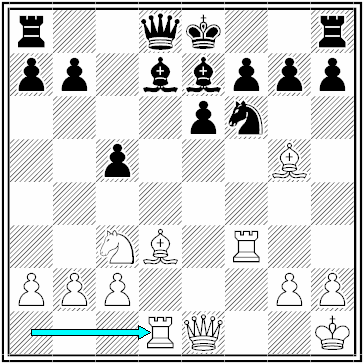
Igor S from Russia then mailed me that black gets the better game after 14...Nbd7 15.000 000 (diagram)
I initially agreed with him, but aftre carefull analysis, it seems to me 16.Kb1 (diagram) gives white full equality :
a/ 16...Bxc3 17.Qxc3 (=)
b/ 16...Qf2 17.Be4 (=)
c/ 16...Qe7 17.Ne4 (=)
d/ 16...Nc5 17.Qc4 Bxc3 18.Qxc3 (=)
e/ 16...Nb6 17.Ne4 (=)
f/ 16...Kb8 17.Qg3+ (=)
So it seems my Russian friend was wrong and that the line 9.Bg2 c6 10.h4 in the Teichmann Defense is certainly not refuted in any way !
Friday, September 13, 2013
Monday, August 19, 2013
The ink was not dry yet
The ink was no dry yet on an earlier post "Disturbing my plans", when i received a mail saying that "...you might have missed something"...
I was trying to demonstrate teh soundness of the line 1.d4 d5 2.e4 dxe4 3.Nc4 Nf6 4.f3 exf3 5.Nxf3 Bg4 6.h3 Bh5 7.g4 Bg6 8.Ne5 e6 9.Bg2 c6 10.h4 Bb4 11.Bg5.
Now I demonstrated that white is better after the natural 11...Nbd7 and has equal chances ( even if white had to trade 6!!! pawns for a piece ) after the challenging 11...Qa5. But last post considered 11...h6 and I suggested 12.Nxg6 fxg6 13.Bxf6 Qxf6 14.Qd3 with equal play.
But the attentive reader might see that black is better after 14...Nbd7 15.000 000.
Back to the drawing table !
I was trying to demonstrate teh soundness of the line 1.d4 d5 2.e4 dxe4 3.Nc4 Nf6 4.f3 exf3 5.Nxf3 Bg4 6.h3 Bh5 7.g4 Bg6 8.Ne5 e6 9.Bg2 c6 10.h4 Bb4 11.Bg5.
Now I demonstrated that white is better after the natural 11...Nbd7 and has equal chances ( even if white had to trade 6!!! pawns for a piece ) after the challenging 11...Qa5. But last post considered 11...h6 and I suggested 12.Nxg6 fxg6 13.Bxf6 Qxf6 14.Qd3 with equal play.
But the attentive reader might see that black is better after 14...Nbd7 15.000 000.
Back to the drawing table !
Saturday, August 10, 2013
Back again - the value of development
I am back agaon from a two week holiday in France where I met some interesting chess-related people, but more on that later.
My first 3 minute game after I came home showed how to take advantage of a player that refuses to develop his minor pieces..., a deadly sin Blackmar Diemer gambiteers never fall into.
Guido De Bouver - ??
1.d4 e5 2.dxe5 Qe7 3.Nf3 Nc6 4.Nc3 (diagram)
4...Nxe5 5.e4 (diagram)
A strong reply. I used to play this kind of gambits myself, but stopped doing so after a number of awfull defeats.
5...Nf6 6.Nxe5 Qxe5 7.f4 Qa5 8.Bd2 (diagram)
White's advantage is obvious.
8...Qb6 ??
Refusing to develop pieces...
9.e5 Ng8 10.Qf3 (diagram)
Black's position is tragicomic.
10...Be7
At last, a minor piece is developed - but too late...
11.000
Missing the immediate punishment 11.Nd5
11...d6 12.Nd5
Now I saw it
12...Qc5 13.Bb4 (diagram)
Black resigns as he will loose his majesty ( eg 13...Qc6 14.Bb5 )
A fair punishment for playing a gambit whilst not developing !
My first 3 minute game after I came home showed how to take advantage of a player that refuses to develop his minor pieces..., a deadly sin Blackmar Diemer gambiteers never fall into.
Guido De Bouver - ??
1.d4 e5 2.dxe5 Qe7 3.Nf3 Nc6 4.Nc3 (diagram)
4...Nxe5 5.e4 (diagram)
A strong reply. I used to play this kind of gambits myself, but stopped doing so after a number of awfull defeats.
5...Nf6 6.Nxe5 Qxe5 7.f4 Qa5 8.Bd2 (diagram)
White's advantage is obvious.
8...Qb6 ??
Refusing to develop pieces...
9.e5 Ng8 10.Qf3 (diagram)
Black's position is tragicomic.
10...Be7
At last, a minor piece is developed - but too late...
11.000
Missing the immediate punishment 11.Nd5
11...d6 12.Nd5
Now I saw it
12...Qc5 13.Bb4 (diagram)
Black resigns as he will loose his majesty ( eg 13...Qc6 14.Bb5 )
A fair punishment for playing a gambit whilst not developing !
Wednesday, July 17, 2013
Disturbing my plans.
Let my apologise first for my long absence - I was quite busy professionaly and had a week's holiday in Italy.
In my quest to demonstrate a theoretical equal line for white in the Teichman defense, I am looking at the "dubious" 11.Bg5 after 1.d4 d5 2.e4 dxe4 3.Nc4 Nf6 4.f3 exf3 5.Nxf3 Bg4 6.h3 Bh5 7.g4 Bg6 8.Ne5 e6 9.Bg2 c6 10.h4 Bb4
In earlier blogs, I proved that the attacker is better after the natural 11...Nbd7 and has equal chances ( even if white had to trade 6!!! pawns for a piece ) after the challenging 11...Qa5.
Let's look today at 11...h6 (diagram), another black try to disrupt white's plans.
It seems to me that this weakens black's position in two ways :
1. a timely exchange of the bishop on g6 yields a double pawn on g6 and an isolani on e6
2. white may consider sacrifing his bishop on h6 when black castles into it.
Unfortunately, my silicon assistant does not always see things the way I see them... As an example, Stockfish first thinks 12.Nxg6 is roughly equal, but, when thinking deeper, prefers 12.Bf4, then switches back to 12.Nxg6, then again 12.Bf4. So it is clear Stockfish is confused.
Let's look at both lines.
a/ 12.Nxg6 fxg6 (diagram)
Let's look at three different white lines
...a1/ 13.Bxf6
......a1a/ 13...Qxf6 14.Qd3
.........a1a1/ 14...Bxc3+ 15.bxc3 Nd7 16.g5 (=)
.........a1a2/ 14...00 15.000 (+=)
.........a1a3/ 14...Nd7 15.000 (=)
In my quest to demonstrate a theoretical equal line for white in the Teichman defense, I am looking at the "dubious" 11.Bg5 after 1.d4 d5 2.e4 dxe4 3.Nc4 Nf6 4.f3 exf3 5.Nxf3 Bg4 6.h3 Bh5 7.g4 Bg6 8.Ne5 e6 9.Bg2 c6 10.h4 Bb4
In earlier blogs, I proved that the attacker is better after the natural 11...Nbd7 and has equal chances ( even if white had to trade 6!!! pawns for a piece ) after the challenging 11...Qa5.
Let's look today at 11...h6 (diagram), another black try to disrupt white's plans.
It seems to me that this weakens black's position in two ways :
1. a timely exchange of the bishop on g6 yields a double pawn on g6 and an isolani on e6
2. white may consider sacrifing his bishop on h6 when black castles into it.
Unfortunately, my silicon assistant does not always see things the way I see them... As an example, Stockfish first thinks 12.Nxg6 is roughly equal, but, when thinking deeper, prefers 12.Bf4, then switches back to 12.Nxg6, then again 12.Bf4. So it is clear Stockfish is confused.
Let's look at both lines.
a/ 12.Nxg6 fxg6 (diagram)
Let's look at three different white lines
...a1/ 13.Bxf6
......a1a/ 13...Qxf6 14.Qd3
.........a1a1/ 14...Bxc3+ 15.bxc3 Nd7 16.g5 (=)
.........a1a2/ 14...00 15.000 (+=)
.........a1a3/ 14...Nd7 15.000 (=)
......a1b/ 13...gxf6 14.Qd3 (+=)
......a1c/ 13...Bxc3 14.bxc3 Qxf6 15.Rb1 (=)
...a2/ 13.Bf4
......a2a/ 13...Bxc3 14.bxc3 (=)
......a2b/ 13...Nd5 14.Bd2 (=+)
......a2c/ 13...00 14.00 (=+)
...a3/ 13.Be3
......a3a/ 13...Bxc3 14.bxc3 (=)
......a3b/ 13...Qd6 14.00 (=+)
......a3c/ 13...Nd5 14.Qd3 (=)
......a3d/ 13...00 14.00 (=)
......a3c/ 13...Nd5 14.Qd3 (=)
......a3d/ 13...00 14.00 (=)
b/ 12.Bf4 (diagram)
...b1/ 12...Nd5 13.Nxg6
......b1a/ 13...Bxc3+ 14.bxc3 fxg6 15.00 (=)
......b1b/ 13...fxg6 15.00 (=)
...b2/ 12...Be4 13.Bxe4 (=)
...b3/ 12...Bh7 13.g5 (=)
...b4/ 12...Ne4 13.Nxg6 Nxc3 14.bxc3 Bxc3+ 15.Bd2 (=)
...b5/ 12...Nbd7 13.Nxg6 fxg6 14.Qd3 (=)
...b6/ 12...Nfd7 13.Nxg6 fxg6 14.Qd3 (+)
...b7/ 12...Nfd7 13.Nxg6 fxg6 14.Qd3 (+)
...b8/ 12...00 13.00 (=+)
...b4/ 12...Ne4 13.Nxg6 Nxc3 14.bxc3 Bxc3+ 15.Bd2 (=)
...b5/ 12...Nbd7 13.Nxg6 fxg6 14.Qd3 (=)
...b6/ 12...Nfd7 13.Nxg6 fxg6 14.Qd3 (+)
...b7/ 12...Nfd7 13.Nxg6 fxg6 14.Qd3 (+)
...b8/ 12...00 13.00 (=+)
So we see that the challenging 11...h6 is no roadblocker for playing 9.Bg2 c6 10.h4 Bb4 11.Bg5 in the Teichmann defense. The retreat 12.Bf4 might be a bit shaky after 12...00, but the immeidate 12.Nxg6 fxg6 13.Bxf6 offers white an equal game.
Sunday, June 16, 2013
Forced lines all along
Last post, I covered a line in the Teichmann defense 1.d4 d5 2.e4 dxe4 3.Nc4 Nf6 4.f3 exf3 5.Nxf3 Bg4 6.h3 Bh5 7.g4 Bg6 8.Ne5 e6 9.Bg2 c6 10.h4 Bb4 11.Bg5 ?!
I showed that white is on top aftre the natural move 11...Nbd7 12.h5.
Unfortunately for the line, black has some otehr choices. as an example, Scheerer indicates 11.Bg5 to be "dubious" and suggests 11...Qa5 after which 12.Bd2 Qb6 13.h5 Qxd4 14.Nf3 Qxg4 15.hxg6 Qxg6 "...Black has four pawns for the piece and went on to win in E.Stadler-G.Haika, correspondence 2000."
Hmm, that's a bit of a setback. Let's start at 11...Qa5 12.Bd2 (diagram)
My silicon assistant only gives 12...Qb6 here ( 12...Qc7 13.Qe2 += ) followed by 13.h5 Qxd4 14.Nf3 (diagram)
Again, Scheerer's line is confirmed and 14...Qxg4 15.hxg6 is suggested.
Black may deviate now with 15...Qxg2 but this greedy capture is punished by 16.gxf7+ (+)
Another option is 15...Qg3+ 16.Kf1 but this is better for white than the main line.
So Scheerer was completely right - black has 4 pawns for the piece. But is black also winning ? Let's look after 16.Qe2 (diagram)
Faithfull Houdini now suggests 3 lines
a/ 16...Bxc3 17.Bxc3 Qg3+ 18.Kf1 (+=)
b/ 16...Qg3+ 17.Kf1
...b1/ 17...Nbd7 18.Rh3
......b1a/ 18...Qc7 19.Nb5 cxb5 20.Bxb4 Nd5 21.Be1 (+=)
......b1b/ 18...Qb8 19.Ne1 (+=)
......b1c/ 18...Qd6 19.a3 (+=)
......b1d/ 18...Qg6 19.Nb5 (+=)
I showed that white is on top aftre the natural move 11...Nbd7 12.h5.
Unfortunately for the line, black has some otehr choices. as an example, Scheerer indicates 11.Bg5 to be "dubious" and suggests 11...Qa5 after which 12.Bd2 Qb6 13.h5 Qxd4 14.Nf3 Qxg4 15.hxg6 Qxg6 "...Black has four pawns for the piece and went on to win in E.Stadler-G.Haika, correspondence 2000."
Hmm, that's a bit of a setback. Let's start at 11...Qa5 12.Bd2 (diagram)
My silicon assistant only gives 12...Qb6 here ( 12...Qc7 13.Qe2 += ) followed by 13.h5 Qxd4 14.Nf3 (diagram)
Again, Scheerer's line is confirmed and 14...Qxg4 15.hxg6 is suggested.
Black may deviate now with 15...Qxg2 but this greedy capture is punished by 16.gxf7+ (+)
Another option is 15...Qg3+ 16.Kf1 but this is better for white than the main line.
So Scheerer was completely right - black has 4 pawns for the piece. But is black also winning ? Let's look after 16.Qe2 (diagram)
Faithfull Houdini now suggests 3 lines
a/ 16...Bxc3 17.Bxc3 Qg3+ 18.Kf1 (+=)
b/ 16...Qg3+ 17.Kf1
...b1/ 17...Nbd7 18.Rh3
......b1a/ 18...Qc7 19.Nb5 cxb5 20.Bxb4 Nd5 21.Be1 (+=)
......b1b/ 18...Qb8 19.Ne1 (+=)
......b1c/ 18...Qd6 19.a3 (+=)
......b1d/ 18...Qg6 19.Nb5 (+=)
...b2/ 17...Qc7 18.a3 (+=)
...b3/ 17...Be7 18.Rh3 (+=)
...b4/ 17...Bxc3 18.Bxc3 (+=)
...b5/ 17...Qg6 18.Nb5 (+=)
...b3/ 17...Be7 18.Rh3 (+=)
...b4/ 17...Bxc3 18.Bxc3 (+=)
...b5/ 17...Qg6 18.Nb5 (+=)
...b6/ 17...00 18.Ne4 Nxe4 19.Qxe4 (++)
c/ 16...Qxc2 17.Nd4 Qxb2 18.Rb1 Qxc3 19.Rxb4 !!
...c1/ 19...Qc5 20.Rh4 (=)
...c2/ 19...Qg3+ 20.Kf1 00 21.Rxb7 (+=)
...c3/ 19...Qa1+ 20.Kf2 Qxa2 21.Nf5 (++)
So it seems to me that Scheerer was right - white has to give an awfull lot of pawns for the piece. But I disagree that black is winning. Its seems to me only line c1 gives black an equal games, and white is on top in all other lines, even if white has given 4 or 5 pawns for the piece.
Wednesday, June 12, 2013
Milking the position
In dutch, "milking the position" means that the player manoeuvres very slowly and carefully as to exploit a very small positional advantage. Of course, that does apply to the vast majority of Blackmar Diemer positions, but still, you might need to do so as to show an advantage.
I learned that the Teichmann defense might give black a smalkl advantage after1.d4 d5 2.e4 dxe4 3.Nc4 Nf6 4.f3 exf3 5.Nxf3 Bg4 6.h3 Bh5 7.g4 Bg6 8.Ne5 e6 9.Qf3 c6 10.g5 Nh5.
So I decided to look into 9.Bg2 c6 10.h4 Bb4 and showed that white has equality.
But is there an advantage for teh attacker. My earlier analysis only considered 11.00. So let's look today at 11.Bg5 (diagram) and see if this one can bring white an advantage.
The move looks rather stupid, as it seems to block the advance of the g pawn.
The most natural black move in this position is clearly 11...Nbd7, attacking white's outpost. However white can now can a small advantage attacking the bishop 12.h5 (diagram)
a/ 12...Nxe5 13.dxe5
...a1/ 13...Qxd1+ 14.Rxd1
......a1a/ 14...Be4 15.exf6 Bxg2 16.Rh2 (+=)
......a1b/ 14...Bxc2 15.exf6 (+=)
......a1c/ 14...Ne4 15.Bd2 (+=)
I learned that the Teichmann defense might give black a smalkl advantage after1.d4 d5 2.e4 dxe4 3.Nc4 Nf6 4.f3 exf3 5.Nxf3 Bg4 6.h3 Bh5 7.g4 Bg6 8.Ne5 e6 9.Qf3 c6 10.g5 Nh5.
So I decided to look into 9.Bg2 c6 10.h4 Bb4 and showed that white has equality.
But is there an advantage for teh attacker. My earlier analysis only considered 11.00. So let's look today at 11.Bg5 (diagram) and see if this one can bring white an advantage.
The move looks rather stupid, as it seems to block the advance of the g pawn.
The most natural black move in this position is clearly 11...Nbd7, attacking white's outpost. However white can now can a small advantage attacking the bishop 12.h5 (diagram)
a/ 12...Nxe5 13.dxe5
...a1/ 13...Qxd1+ 14.Rxd1
......a1a/ 14...Be4 15.exf6 Bxg2 16.Rh2 (+=)
......a1b/ 14...Bxc2 15.exf6 (+=)
......a1c/ 14...Ne4 15.Bd2 (+=)
......a1d/ 14...Bxc3+ 15.bxc3 (+=)
...a2/ 13...Be4 14.Qxd8+ Rxd8 15.exf6 Bxg2 16.fxg7 Rg8 17.Rg1 (+=)
...a3/ 13...Bxc3+ 14.bxc3 (+=)
...a4/ 13...Qa5 14.exf6 Qxg5 15.hxg6 (+=)
b/ 12...Qa5 13.Bxf6
...b1/ 13...Bxc3+ 14.bxc3 Qxc3 15.Kf2 (+=)
...b2/ 13...gxf6 14.Nxd7 (+=)
c/ 12...Bxc3+ 13.bxc3 (transposing to other lines ) (+=)
d/ 12...Be4 13.Bxe4 Nxe5 14.Bxf6 (+=)
e/ 12...Qc7 13.Bxf6 (+=)
So we see that whote can get a small advanatge aftre the natural move 12...Nbd7. Unfortunately, black has some other moves, which we will analyse on a further post.
Wednesday, June 5, 2013
Zilbermints gambit in the Euwe defense
I admit - I am touching a very delicate item right now. Something that will certainly stir angry reactions. But nonetheless, I am covering it - the Zilbermints gambit in the Euwe defense occuring aftrer 1.d4 d5 2.e4 dxe4 3.Nc3 Nf6 4.f3 exf3 5.Nxf3 e6 6.Bg5 Be7 7.Bd3 Nc6 8.00 Nxd4 and now 9.Kh1 (diagram).
I once showed this gambit-in-a-gambit to an IM friend of mine, and he felt really annoyed. "Why do you show this to me ?", he asked. "Do you want to test me on my defensive skills ?". Me, a mere mortal, I did not dare to answer this obvious question with a honest answer, so I just repsonded with a simple "I just wanted to know what you would play against this aggresive move." So he looked at the board for a few minutes and played 9...c5.
Okay, I expected that one. "Can't be bad - I protect my outpost and make some space for the queen", he added.
Since then, I have always distrusted the Zilbermints gambit. Maybe it is me being an engineer, wanting a clear path ahead for every move, that narrows my eyesight, but I cant see any white plan here.
Let's consider 10.Qe1 (what else) followed by the simple exchnage 10...Nxf3 11.Rxf3 (diagram). Note that black has stronger 10th moves and that taking the knight is rather silly now, aftre having defended it first with c5, but anyway.
My silicon assistant now gives 3 moves that give the defender the advantage : 11...Bd7, 11...a6 and 11...h6. Of course, white can only dream of black castling now into it, but that is not real chess, but wishfullthinking chess.
Let's consider 11...Bd7. Houdini suggests 12.Rad1 (diagram) - who am I to doubt that ?
Houdini now suggests 5 black moves with a black advantage - surely there will be one that allows black to exchange some pieces ? 12...a6 is recommended, but let's look at 12...Bc6 (diagram)
To me, it seems the attacker has less than anything here. Sure, black has not yet castled and his queen is about to be x-rayed, but all of white's threats can be answered.
Summary, the Zilbermints gambit in the Euwe defense is to be respected, but not to be feared and there are many black lines leading to a black advantage.
Okay, I expected that one. "Can't be bad - I protect my outpost and make some space for the queen", he added.
Since then, I have always distrusted the Zilbermints gambit. Maybe it is me being an engineer, wanting a clear path ahead for every move, that narrows my eyesight, but I cant see any white plan here.
Let's consider 10.Qe1 (what else) followed by the simple exchnage 10...Nxf3 11.Rxf3 (diagram). Note that black has stronger 10th moves and that taking the knight is rather silly now, aftre having defended it first with c5, but anyway.
My silicon assistant now gives 3 moves that give the defender the advantage : 11...Bd7, 11...a6 and 11...h6. Of course, white can only dream of black castling now into it, but that is not real chess, but wishfullthinking chess.
Let's consider 11...Bd7. Houdini suggests 12.Rad1 (diagram) - who am I to doubt that ?
Houdini now suggests 5 black moves with a black advantage - surely there will be one that allows black to exchange some pieces ? 12...a6 is recommended, but let's look at 12...Bc6 (diagram)
To me, it seems the attacker has less than anything here. Sure, black has not yet castled and his queen is about to be x-rayed, but all of white's threats can be answered.
Summary, the Zilbermints gambit in the Euwe defense is to be respected, but not to be feared and there are many black lines leading to a black advantage.
Subscribe to:
Posts (Atom)