Friday, May 18, 2012

That's the same, isn't it ?

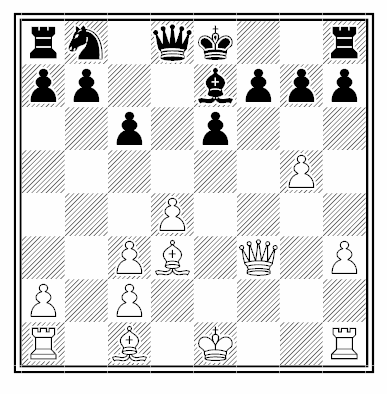
I had some problems lately playing against a strange Vienna-like line, occuring after 1.d4 d5 2.e4 dxe4 3.Nc3 Bf5 4.f3 exf3 (diagram).

White has two options now : 5.Qxf3 and 5.Nxf3. The Ryder-like continuation 5.Qxf3 seems more direct as it attacks both the pawn at b7 and the bishop on f5. Unfortunately, black has the simple, but very effective 5...Qc8 and white has difficulties in creating an attack

So I advise it is better to stick to 5.Nxf3 (diagram), with followng options :

a/ 5...Nf6 6.Ne5 (Gunderam defense)

b/ 5...c6 (A Karo Cann without Nf6) 6.Bd3
...b1/ 6...Bxd3 7.Qxd3 (=) and white has a nice lead in development
...b2/ 6...Bg6 7.Bg5 (=)
...b3/ 6...Bg4 7.h3 (+=)

c/ 5...e6 6.Bd3
...c1/ 6...Bxd3 7.Qxd3 (=)
...c2/ 6...Ne7 7.Bf4 (=)
...c3/ 6...Bg6 7.Bxg6 hxg6 8.Qe2 (=)

d/ 5...Nc6 6.d5 (+=)

e/ 5...Ne7 6.Nh4

The alternative 5.Qxf3 Qc8 6.Bf4 (diagram) also does not seem to bring any advantage for the attacker, eg 6...Nf6 with complete equality.

So it seems that this is a completely different line, as black has a much simpler game defending. Most lines seem to equlize rather quickly. I will remember this option if someone dares to venture a Blackmar Diemer against me !

Wednesday, May 9, 2012

Not that easy

My previous post covered a line in the Teichmann defense : 1.d4 d5 2.e4 dxe4 3.Nc3 Nf6 4.f3 exf3 5.Nxf3 Bg4 6.h3 Bh5 7.g4 Bg6 8.Ne5 with black now attacking white's outpost on e5 with 8...Nfd7 or the more natural 8...Nbd7.

We learned that white gets a small advantage after 8...Nfd7 and that black can obtain equality after 8...Nbd7 9.Qf3 c6 10.Nxg6 hxg6 11.g5.

Now there is also the line 8...Nbd7 9.Qf3 e6. Houdini, at a depth of 22, sees a tiny white advantage but rates both 10.Qxb7 and 10.Nxg6 the same. To determine which one is best, let's look first at 10.Qxb7 (diagram).

a/ 10...Nxe5 11.dxe5
...a1/ 11...Nd7 12.Bb5 Rb8 13.Qxa7
......a1a/ 13...Qh4+ 14.Qf2 (=)
......a1b/ 13...Bb4 14.Bxd7+ Kxd7 15.Be3 (+=)
......a1c/ 13...Be7 14.Be3 (+=)
......a1d/ 13...Ra8 14.Qf2 (+=)
......a1d/ 13...Rxb5 14.Nxb5 Bb4+ 15.Bd2 Bxd2+ 16.Kxd2 Nxe5 17.Kc3 (+=)
...a2/ 11...Rb8 13.Bb5 Nd7 transposing to a1.

b/ 10...Rb8 11.Qxa7
...b1/ 11...Nxe5 12.dxe5 Nd7 13.Bb5 transposing to a1.
...b2/ 11...Ne4 12.Nxd7 Kxf7 13.Qa4+ c6 14.Qa7+ (=)
...b3/ 11...Ra8 12.Qb7 (=)

The lines after 10.Nxg6 hxg6 11.Bg2 (diagram) are quite different :

c/ 11...c6 12.Rf1 Qe7 13.Bg5 (+=)

d/ 11...Bd6 12.00 00 13.Qxb7 (=)

e/ 11...Be7 12.Qxb7 (+=)

f/ 11...Bb4 12.00 (+=)

g/ 11...c5 12.Be3 (=)

h/ 11...Rb8 12.Rf1 (+=)

i/ 11...Qc8 12.Rf1 (+=)

j/ 11...Nb6 12.g5 (+=)

So overall, it seems that the continuation 10.Nxg6 hxg6 11,Bg2 offers the attacker better chances than 10.Qxb7.

Friday, May 4, 2012

What a difference those additionals bits make

I upgraded my laptop some time ago from Windows 7 32 bit to 64 bit and moved to the 64 bit version of Houdini. What a difference these additional bits make ! It seems that my analysis runs a lot faster and deeper now. I am looking forward to the 128 bit version of the operating system - imagine what a difference that will make in chess analysis ?

In my book "Attack with the Blackmar Diemer, I covered a line in the Teichmann incorrectly. After 1.d4 d5 2.e4 dxe4 3.Nc3 Nf6 4.f3 exf3 5.Nxf3 Bg4 6.h3 Bh5 7.g4 Bg6 8.Ne5 Nfd7, I suggested 9.Bg2 which leads to nothing after 9...Nxe5 10.Bxb7 N8c6 11.dxe5 Qxd1+ 12.Nxd1 Be4

But I now find that 9.Nxg6 hxg6 10.Bg5 (diagram) is far better.

a/ 10...f6 11.Qd3 (+)

b/ 10...c6 11.Qe2 (+=)

c/ 10...c5 11.d5 (+=)

d/ 10...Nc6 11.Bg2 (+=)

e/ 10...Nf6 11.Qf3 (+=)

f/ 10...Nb6 11.Qd3 (+=)

In the related line 8...Nbd7 (diagram), I suggested 9.Qf3. But now I see that 9.Nxg6 is also possible, often transposing. But since 9.Qf3 yields a more complicated play, I will keep this as the recommended move.

g/ 9...c6 10.Nxg6 hxg6 11.g5
...g1/ 11...Nh5 12.Bc4
......g1a/ 12...e6 13.Rf1 Qe7 14.Bd2 (=)
......g1b/ 12...f5 13.gxf6 exf6 14.Bd2 (=)
......g1c/ 12...f6 13.Qe4 (+=)
...g2/ 11...Nh7 12.h4 (+=) (Improving on 12.Bc4 I suggested earlier)
...g3/ 11...Nd5 12.Nxd5 cxd5 13.Qxd5 (+=)
...g4/ 11...Ng8 12.Bc4
......g4a/ 12...e6 13.Rf1 (+=) (Improving on 13.00)
......g4b/ 12...f5 13.Be6 (++) (Improving greatly on 13.Be3)

h/ 9...e6 10.Qxb7 ( or 10.Nxg6 )
Will be covered in a following post

i/ 9...Nxe5 10.dxe5 Nd7 11.e6 fxe6 12.Qxb7 (+=)

j/ 9...c5 10.Be3 (+)

k/ 9...Rb8 10.h4 (+)

So my 32 additional bits really make the difference, as more and more small white advantages appear on the board !

Thursday, April 26, 2012

How do I explain this to the children ?

My silicon chess friend often suggests moves that are hard to understand – at least for me, a mere woodchopper...

As an example, in the Pohlmann defense, Houdini recommends 6.Bb5+ (diagram) after 1.d4 d5 2.e4 dxe4 3.Nc3 f5 4.f3 exf3 ( Scheerer prefers 4...e5, but I doubt his analysis as he relies on Milov-Kramnik, 1990, but Milov could have improved by playing 7.Nb5 instead of 5.dxe5 Qxd1+ 6.Kxd1 Nc6 7.Nd5 ) 5.Nxf3 Nf6. Now I teach chess to children and I always learn them that giving a check like that is not so good, as it allows the defender to chase away the bishop with the simple c6. Applying that golden rule would indicate that 6.Bc4 is preferred over 6.Bb5+. Still Houdini recommends the latter over the logical 6.Bc4. Why ? Well, let's look at the different ways of dealing with the check.

a/ 6...c6 The most simple way of blocking the check 7.Bc4 (diagram)
The attacker has now taken away the natural black move Nc6.
...a1/ 7...b5 8.Bb3 e6 9.Ng5 b4 10.Na4 (=)
...a2/ 7...e6 8.Qe2 (+=)
...a3/ 7...g6 8.Qe2 (+=)
...a4/ 7...c5 8.Bf4 (+)
...a5/ 7...Nbd7 8.Ng5 (+=)
...a6/ 7...Na6 8.Ng5 (+=)
...a7/ 7...Nd5 8.Bg5 (+=)
...a8/ 7...Qc7 8.00 (+=)
...a9/ 7...Qb6 8.00 (+)

b/ 6...Bd7 7.Qe2 (diagram)
White develops pieces
...b1/ 7...Nc6 8.Bg5 (+)
...b2/ 7...c6 8.Bc4 (+=)
...b3/ 7...a6 8.Bxd7 Qxd7 9.Bg5 (+=)
...b4/ 7...c5 8.Bf4 (+)
...b5/ 7...e6 8.Bf4 (+=)
...b6/ 7...g6 8.Bf4 (+)

c/ 6...Nc6 7.d5 a6 8.Ba4 b5 9.Nxb5 axb5 10.Bxb5 (+=)

d/ 6...Nbd7 7.Ng5 c6 8.Bc4 Nd5 9.Ne6 (+)

So analysis proves that white gets a small advantage after 6.Bb5+. After 6.Bc4, black is able to equalise with 6...e6 (diagram).
In this position 7.Qd3 Nc6 (=) is probably best.

So Houdini was right, in this case 6.Bb5+ is better than 6.Bc4 as it denies black to place his knight on the c6 square. But as a general rule, I will stick to telling children that Bc4 is better...

Monday, April 23, 2012

Presentation by Robert Houdart

Last friday, there was a presentation In Leuven ( Flanders ) on chess engines by Robert Houdart, the Flemish author of Houdini. You can read a summary here.

It is in Dutch, but I am sure you will get the point. Really interesting stuff !

Interesting is also a grat Rybka - Houdini game :


The commentator gets lyrical about Houdini's romantic style, allowing old gambits ( such as the Blackmar Diemer... ) to be revived.

Friday, April 20, 2012

A (very) thematic sacrifice

In my book "Attack with the Blackmar Diemer", I have covered the line in the Seidel hall attack 1.d4 d5 2.e4 dxe4 3.Nc3 Nf6 4.f3 exf3 5.Nxf3 Bg4 6.h3 Bxg4 7.Qxf3 c6 8.g4 e6 9.g5 Nd5 10.Bd3 Nxc3 11.bxc3 ( In an earlier blog, I indicated that 10...Nxc3 could be answered potentially by 11.00 ) Be7.

In my book, I suggested the thematic sacrifice 12.00 00 13.Bxh7+ Kxh7 14.Qh5+ Kg8 15.Rxf7 ( diagram ), but it seems black can escape with a draw after 15...Qa5 as white has no other chioce than accepting the draw with 16.Rxg7+ Kxg7 17.Qh6+

If white wants to play for a win, 12.00 00 13.Rb1 ( diagram ) might offer the best choices. But then the same sacrifice is again available in all lines.

a/ 13...b6 14.Bxh7+ Kxh7 15.Qh5+ Kf8 18.Rxf7 and black's strongest move ( Qa5 ) is not available anymore as the b6 pawn is in the way (+=)

b/ 13...b5 14.Bxh7+ Kxh7 15.Qh5+ Kg8 16.Rxf7 (+)

c/ 13...Qc8 14.Bxh7+ Kxh7 15.Qh5+ Kg8 16.Rxf7 (++)

d/ 13...Qd7 14.Bxh7+ Kxh7 15.Qh5+ Kg8 16.Rxf7 (++)

e/ 13...Qc7 14.Bxh7+ Kxh7 15.Qh5+ Kg8 16.Rf4 ( the sacrifice on f7 is not possible as white can deliver check on g3 ) and white has a draw. Obviously, 14.Bf4 is better than 14.Bxh7+, but it shows that the sacrifice is possible in all lines.

SO it seems like this is a very usefull sacrifice to be remembered !

Sunday, April 8, 2012

Odd moves in the Kaulich defense

The Brombacher counter is a great weapon for black when decling the Blackmar Diemer. Why ? Not because it is so good, just because it denies white the normal attacking patterns.

The normal line is 1.d4 d5 2.e4 dxe4 3.Nc3 Nf6 4.f3 c5 5.d5 ( Brombacher counter gambit ).

Black's strongest move is now 5...exf3 6.Nxf3 (diagram), transposing into the Kaulich defense.

6...a6 (!?) (diagram) is now recommended by Houdini, but this strange move is not even considered by Christoph Scheerer. It seems to me Houdini wants to avoid some kind of "Gedult variatiation" with Bf4 and Nb5.

How should the attacker proceed ? Let's try some options.

a/ 7.Bf4 can be answered by 7...e7 and white has less than nothing (=+)

b/ 7.Bg5 is probably better than 7.Bf4 but black can chase away the bishop 7...h6 8.Bh4 g5 9.Bf2 Qb6 (=+)

c/ 7.Be3 Nbd7 (=) and white is fighting for equality

d/ 7.Bd3 (=+) gives black the luxury of choices between 7...g6 and 7...e6

e/ 7.Bc4 b5 8.Bd3 (=+) is even worse

f/ The modest 7.Be2 leads nowhere after 7...e6 (=+)

g/ 7.Qd3 runs into 7...b5 (=+)

h/ The waiting 7.a4 (diagram) is maybe best.
7.a4 alllows for white to put his bishop on it's strongest outpost : c4.
The line 7.a4 g6 8.Bc4 Bg7 9.Bf4 00 10.00 seems to give equlaity, but then again, other black seventh moves are possible.

Bottomline, the odd 6...a6 in the Kaulich defense needs to be considered carefully. More investigation is needed, but it seems another oddity 7.a4 is best.