Monday, January 27, 2014

Too dull for a gambiteer

My opponent yesterday avoided my Blackmar Diemer by a boring line which ended, not unexpectedly, in a draw.

1.d4 Nf6 2.f3 e6 3.e4 d5 (diagram)

My opponent, a geniune French defense player, did not want to take any risk at all. I continued with the obvious 4.e5 Nfd7 5.f4 aftre which a drawish game occured.

But can the attacker avoid these French lines after 1.d4 Nf6 2.f3 e6 3.e4 d5. I guess there are some candidates : 4.Nc3 and 4.Be3, the last one resembling an Alapin gambit. Let's look at that one today and explore some possible lines.

4.Be3 dxe5 5.fxe4 (diagram - 5.Nc3 is not good as white has wasted one move compared to a regular Euwe defense, so only 5.fxe4 is avaliable )
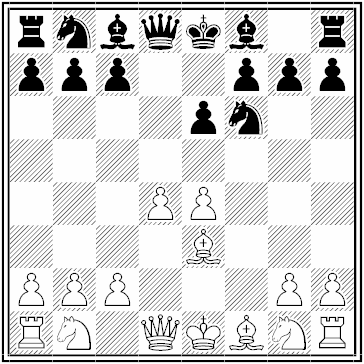
Aftre black eating the e4 pawn 5...Nxe4, white plays 6.Nd2. Whiet can equalize and develop quickly if now 6...Nxd2 7.Qxd2 (=)

If black retreats the knight to f6, white also develops quickly and equalises 6...Nf6 7.Ngf3 (=)

Retreating to d6 is a different option 6...Nd6 7.Nf3 (=)

Protecting the knight on its outpost on e4 is no option as 6...f5 7.Nxe4 fxe4 8.Qh5+ as awfull, and 6...Qd5 7.Bc4 brings out the black queen unnecessarily.

So 4.Be3 dxe4 5.fxe4 Nxe4 is not to be feared, as white has a nice lead in development for the pawn.

Let's look at the most typical French move 4...c5 5.dxc5 (diagram)
This was the move that white was trying to prevent aftre all when playing 4.Be3, so it is no wonder white is ok here.

Developing quietly is the third option for black, eg 4...Be7. White can now obvioulsy return to the typical French Tarrasch-like lines aftre 5.e5 Nfd7 6.f4, but we wanted to avoid these boring lines. So why not 5.Nc3 here ? Pinning the knight would be a waste of time. Houdini gives me complete equaliyty here.
So it seems the 4.Be3 is playable and avoids the boring Tarrasch lines.

To be noted is that 1.e4 e6 2.d4 d5 3.Nc3 Nf6 4.Be3 is called the Henneberger Variation of the French.

Stay posted for more


Sunday, December 22, 2013

Yet another improvement

I was looking for improvements on my game last week, where my opponent was baffled by my audacious 1.d4 d5 2.e4 dxe4 3.Nc3 Nf6 4.f3 exf3 5.Nxf3 Bg4 6.h3 Bh5 7.g4 Bg6 8.Ne5 e6 9.Qf3 Nd5 10.Bb5+ c6 11.0-0.

My opponent choose the inferior 11...f6, but I realised black would get trhe upper hand aftre the correct 11...Nf6, as 12.Rf2 complicates things even further, but black remains on top after the simple 12...Be7.

But now I see that 11.0-0 is in fact the bad move ! 11.Rf1 (diagram) is much stronger.

a/ 11...Qh4+ 12.Kd1
...a1/ 12...cxb5 13.Nxd5 (++)
...a2/ 12...Nxc3+ 13.bxc3 (+=)
...a3/ 12...Be7 13.Nxd5 (+=)
...a4/ 12...f6 13.Nxd5 (++)
...a5/ 12...Qf6 13.Qg2 (=)
...a6/ 12...Qe7 13.Nxd5 (++)
...a7/ 12...Bd6 13.Nxg6 (++)

b/ 11...cxb5 12.Nxg6 (++)

c/ 11...Nf6 12.Be2 (=)

d/ 11...Qf6 12.Nxd5
...d1/ 12...exd5 13.Qxd5 (+=)
...d2/ 12...Qxf3 13.Nc7+ Kd8 14.Rxf3 Kxc7 15.Nxf7 (+)

e/ 11...f6 12.Nxg6 hxg6 13.Bd3 (=)

f/ 11...f5 12.Nxd5 
...f1/ 12...Qxd5 13.Qxd5 exd5 14.Bd3 (+=)
...f2/ 12...exd5 13.Bd3 (+=)

So it seems to me that 11.Rf1 is much stronger than 11.0-0. There is no advantage in sight for black and he will soon be drowning the terrible complications against a well prepared attacker.

Also, black can hold in three lines :
> 11...Qh4+ 12.Kd1 Qf6 Qg2
> 11...Nf6 12.Be2
> 11...f6 12.Nxg6 hxg6 13.Bd3

My next post will focus on these lines.

Monday, December 16, 2013

The jungle of variations

Yesterday afternoon I played an interesting Blackmar Diemer - I didnt win the game, as I lost the way in the jungle of variations myself.

Guido De Bouver - Patrick Colemont
Belgian interclubs. 15-dec-2013.

1.d4 d5 2.e4 dxe4 3.Nc3 Nf6 4.f3 exf3 5.Nxf3 Bg4 6.h3 Bh5 7.g4 Bg6 8.Ne5 e6 9.Qf3
All according to plan - the Teichmann defense

9...Nd5?! (diagram)

Luckily I remembered a great attacking line.
10.Bb5+ c6 11.0-0 (diagram)

11..f6 ?!
The correct move is 11...Nf6 and black should be better somehow, even if 12.Rf2 complicates things for black.

12.Nxg6 hxg6 (diagram)


Now it was turn to make an inferior move :-(
13.Nxd5 ?
The correct move 13.Bd3 should gave given me a small advantage

13...Nxd5 14.Bd3 (diagram)

The defender is better now, but black choose the inferior 14...Kf7.

The remainder of the game was quite spectacular after 15.Be4 Qxd4+ 16.Be3 Qe5, but I was able to secure a draw in a complicated queen versus two rooks endgame.

In any case, I will have to find a decent continuation after black's best move 11.Nf6

Wednesday, November 13, 2013

The Euwe - O'Kelly : One move less also wins

My previous post on the "Euwe - O'Kelly defense" raised some comments. User "Anonymous" suggested 11.Bd3 (diagram) in the position after 1.d4 d5 2.e4 dxe4 3.Nc3 Nf6 4.f3 exf3 5.Nxf3 c6 6.Bc4 e6 7.0-0 Be7 8.Qe1 Nbd7 9.Bg5 0-0 10.Qh4 h6. In my post, I only considered 11.Bxh6 with equal play ( provided black find sthe right moves !! )


This position might seem familiar to the attentive reader as this position can be reached in the EUwe defense after 1.d4 d5 2.e4 dxe4 3.Nc3 Nf6 4.f3 exf3 5.Nxf3 e6 6.Bg5 Be7 7.Bd3 Nbd7 8.0-0 0-0 9.Qe1 c6 10.Qh4 h6. The only difference is that it is white to move in the Euwe, whilst it is black's turn in the Euwe-O'Kelly. Talking about a small difference.

But even with white one move down, it seems that 11.Bd3 is winning !!

a/ 11...hxg5 12.Nxg5 (++)

b/ 11...Nb6 12.Bxh6 (++)

c/ 11...Nd5  12.Nxd5 Bxg5 13.Nxg5 Qxg5 14.Qxg5 hxg5 15.Ne7+ Kh8 16.Rae1 (+=)

d/ 11...Qa5 12.Ne4
...d1/ 12...Re8 13.Rae1 (+)
...d2/ 12...Rd8 13.c3 (+)
...d3/ 12...Bd8 13.b4 (+)
...d4/ 12...hxg6 13.Nexg5 (++)

e/ 11...Qb6 12.Bxh6 (++)

f/ 11...Qc7 12.Bxh6 (++)

g/ 11...c5 12.Bxh6 (++)

Let's consider balck's best reply in more detail : 11...Re8 12.Bxh6 (diagram)

Declining the piece is no option for black :

...h1/ 12...Nf8 13.Ne5 (++)
...h2/ 12...Nd5 13.Nh7+ (++)
...h3/ 12...Qa5 13.Bg5 (++)

And now the killer move 12...gxh6 13.Ne5 !! Analysis shows only 13...Bf8 offers some chances. But now white brings in an extra piece with 14.Rf3 (diagram)

Again, black has only one move 14...Bg7, followed by the logical 15.Rg3 (diagram)

As "Anonymous" pointed out, black has to give back the piece with 15...Ne4, but white stays on top after 16.Qxe4 f5 17.Qe3 Nxe5 18.Qxe5 (+=)

Apparently, the Euwe defense is so strong that it evens wins with the move down !

Thank you "Anonymous" for this great line !

Monday, November 11, 2013

It only gets better

I always had problems dealing with the line 1.d4 d5 2.e4 dxe4 3.Nc3 Nf6 4.f3 exf3 5.Nxf3 Bg4 6.h3 Bh5 7.g4 Bg6 8.Ne5 e6 9.Qf3 c6 10.g5 Ng8 (diagram)

Black retreats his horseman back to square null - safety first. Guess his reasoning is something like "Show me what you have for the pawn !".

And indeed, I have always been struggle with thius move as I could not find an immediate punishment. But now, I finally found the way to victory for white ( rather appropriate wording on this 11th november, when we remember the end of the Geat War ).

The right move is 11.Bd3 Qxd4 - black is obliged to take the pawn to stay in the game as 11...f5`12.gxf6 Qxf6 13.Qg3!! Bxd3 14.Bg5 Qf5 15.cxd3 does not look good at all for black (diagram).

Back to the main line after 11.Bd3 Qxd4 12.Nxg6 hxg6 13.Rf1 (diagram)


Only 13...Qh4+ is feasible here, follwed by 14.Rf2 Bc5 15.Qxf7+ Kd8 16.Ne4.
As 16...Bb6 now fails to 17.Qxb7, black has nothung else than 16...Bxf2+ 17.Nxf2 (diagram). Black is a lot of material ahead, but white has sufficient comprensation :

a/ 17...Nd7 18.Bd2
...a1/ 18...Ne7 19.0-0-0
......a1a/ 19...Nd5 20.Ne4 (+=)
......a1b/ 19...Rf8 20.Qxe6 Rxf2 21.Bc4 (=)
......a1c/ 19...Kc7 20.Qxe7 (+=)
......a1d/ 19...Ne5 20.Qxe6 (++)
...a2/ 18...Kc7 19.Bf4+ (+=)
...a3/ 18...Ne5 19.Qxb7 (+=)

b/ 17...Ne7 18.Bd2 Nd7 ( see a1 )

c/ 17...Qb4+ 18.Bd2 
...c1/ 18...Qe7 19.Qxg6 (+=)
...c2/ 18...Qxb2 19.Qf8+ Kc7 20.Rd1 (++)

So it seems that white had nothing to fear from the timid 10...Ng8 reply in the Teichmann defense

Saturday, November 2, 2013

The Euwe - O'Kelly : defense all the way.

Sometimes my opponents choose very defensive ways of dealing with the Blackmar Diemer, for example 1.d4 d5 2.e4 dxe4 3.Nc3 Nf6 4.f3 exf3 5.Nxf3 c6 6.Bc4 e6 (diagram). This has occured several times in the last weeks. Black deliberately shuts in his lightsquared bishop and takes a very defensive stand.

In the Euwe defense, black plays e6 furst and white places his bishop on d3. In the O'Kelly, black plays c6 first and white then plays Bc4. But this system is a mixture of both.

Most lines will transpose into the Euwe defense, when white will eventually place his bishop back onto d3, but there might be following different ideas.

a/ 7...Nd5 8.Bxd5 exd5 9.Ng5 (+)

b/ 7... b5 8.Bd3 b4 9.Nxe4
...b1/ 9...Nxe4 10.Bxe4 (+=)
...b2/ 9...Nbd7 10.Bf4 (+=)

c/ 7...Nbd7 8.Qe1 (=)

d/ 7...Be7 8.Qe1 (=)

e/ 7...Bd6 8.Qe1 (=)

So white quietly gets all its pieces in an Euwe-like fashion to deliver a tremendous attack. A standard line might be : 7...Be7 8.Qe1 Nbd7 9.Bg5 0-0 10.Qh4 (diagram)

We all know that h6 in the Euwe equivalent of this position is deadly, but this is when the white bishop is on d3, now it is on c4. Does 10...h6 force white to retreat ?

f. 10...h6 11.Bxh6 gxh6 12.Qxh6 (diagram)

It seems to me that black is alive and kicking in this position ! Houdini suggests more than 5 black moves, al equal. The move 12...Nh7 even gives bnlack a small lead. Hmm, let's look at 12...Nh7 (diagram)

Only 13.Bd3 is possible but now the odd looking 13.f5 saves the day for black as 14.Qxe6+ is not sufficient for a win, eg 14...Kh7 15.Rae1 Bf6 (=)

So we see that the Euwe-O'Kelly defense is not without risk for the attacker as the standard Euwe attacking lines might fail.

Thursday, October 3, 2013

Is this winnable ?

Dont know if winnable is correct English. I am just wondering if white can convert a small advantage that occurs in the Teichmann defense into a full point.

Consider the position after 1.d4 d5 2.e4 dxe4 3.Nc3 Nf6 4.f3 exf3 5.Nxf3 Bg4 6.h3 Bh5 7.g4 Bg6 8.Ne5 e6 9.Bg2 c6 10.h4 Nbd7 (diagram)


I discussed the main line 10...Bb4 in length in previous posts, but 10...Nbd7 ( and also 10...Bd6 ) gives interesting, unbalanced positions.

My silicon assistant suggests 11.h5 Nxe5 12.dxe5 Qxd1+ 13.Kxd1 Nxg4 14.hxg6 Nxf2 15.Ke2 Nxh1 16.gxf7+ Kxf7 17.Bxh1 (diagram)

Black has rook and two pawns for the two pieces. Some might say black has the material advantage ( especially in view of the g and h pawns ), but my computer gives white a small plus ?! let's look at the lines

a/ 17...h5 18.Ne4
...a1/ 18...h4 19.Ng5+ Kg8 20.Bg2 (+=)
...a2/ 18...Be7 19.Bf4 (+=)
...a3/ 18...Bb4 19.Ng5+ (+)
...a4/ 18...Rd8 19.Ng5+ (+)
...a5/ 18...Re8 19.Ng5+ (+)

b/ 17...h6 18.Ne4
...b1/ 18...g5 19.Be3 (+=)
...b2/ 18...Be7 19.Be3 (+=)
...b3/ 18...Bb4 19.Be3 (+=)
...b4/ 18...Rd8 19.Be3 (+)

c/ 17...g6 18.Ne4
...c1/ 18...Bg7 19.Nd6+ (+)
...c2/ 18...Be7 19.Bh6 (+)

d/ 17...Bc5 18.Ne4
...d1/ 18...Be7 19.Be3 (+=)
...d2/ 18...Bb6 19.Nd6+ (+)
...d3/ 18...Bd4 19.Nd6+ (+)

e/ 17...Bb4 18.Ne4
...e1/ 18...Be7 19.Be3 (+=)
...e2/ 18...Rd8 19.Ng5+ (+)

f/ 17...Be7 18.Ne4 h5 19.Bf4 (+=)

g/ 17...a6 18.Be3 (+=)

So it quickly becomes clear that the line 17...Be5 18.Ne4 h5 19.Bf4 (diagram) is critical

Does white have something here ? Maybe, maybe not.  Sure wont be easy for either player.